 ++++
++++Notebook converted from Jupyter for blog publishing.
03-Text-Classification-Assessment-Solution

Text Classification Assessment - Solution
Goal: Given a set of text movie reviews that have been labeled negative or positive
For more information on this dataset visit http://ai.stanford.edu/~amaas/data/sentiment/ (opens in a new tab)
Complete the tasks in bold below!
Task: Perform imports and load the dataset into a pandas DataFrame
For this exercise you can load the dataset from '../DATA/moviereviews.csv'{:python}.
# CODE HEREimport numpy as np
import pandas as pddf = pd.read_csv('../DATA/moviereviews.csv')df.head()label
review
0
neg
how do films like mouse hunt get into theatres...TASK: Check to see if there are any missing values in the dataframe.
#CODE HERE# Check for NaN values:
df.isnull().sum()label 0
review 35
dtype: int64TASK: Remove any reviews that are NaN
df = df.dropna()TASK: Check to see if any reviews are blank strings and not just NaN. Note: This means a review text could just be: "" or " " or some other larger blank string. How would you check for this? Note: There are many ways! Once you've discovered the reviews that are blank strings, go ahead and remove them as well. Click me for a big hint (opens in a new tab)
df['review'].str.isspace().sum()27df[df['review'].str.isspace()]label
review
57
neg
71df = df[~df['review'].str.isspace()]df.info()<class 'pandas.core.frame.DataFrame'>
Int64Index: 1938 entries, 0 to 1999
Data columns (total 2 columns):
# Column Non-Null Count Dtype
--- ------ -------------- ----- TASK: Confirm the value counts per label:
#CODE HEREdf['label'].value_counts()pos 969
neg 969
Name: label, dtype: int64EDA on Bag of Words
Bonus Task: Can you figure out how to use a CountVectorizer model to get the top 20 words (that are not english stop words) per label type? Note, this is a bonus task as we did not show this in the lectures. But a quick cursory Google search should put you on the right path. Click me for a big hint (opens in a new tab)
from sklearn.feature_extraction.text import CountVectorizercv = CountVectorizer(stop_words='english')matrix = cv.fit_transform(df[df['label']=='neg']['review'])
freqs = zip(cv.get_feature_names(), matrix.sum(axis=0).tolist()[0])
# sort from largest to smallest
print("Top 20 words used for Negative reviews.")
print(sorted(freqs, key=lambda x: -x[1])[:20])Top 20 words used for Negative reviews.
[('film', 4063), ('movie', 3131), ('like', 1808), ('just', 1480), ('time', 1127), ('good', 1117), ('bad', 997), ('character', 926), ('story', 908), ('plot', 888), ('characters', 838), ('make', 813), ('really', 743), ('way', 734), ('little', 696), ('don', 683), ('does', 666), ('doesn', 648), ('action', 635), ('scene', 634)]matrix = cv.fit_transform(df[df['label']=='pos']['review'])
freqs = zip(cv.get_feature_names(), matrix.sum(axis=0).tolist()[0])
# sort from largest to smallest
print("Top 20 words used for Positive reviews.")
print(sorted(freqs, key=lambda x: -x[1])[:20])Top 20 words used for Positive reviews.
[('film', 5002), ('movie', 2389), ('like', 1721), ('just', 1273), ('story', 1199), ('good', 1193), ('time', 1175), ('character', 1037), ('life', 1032), ('characters', 957), ('way', 864), ('films', 851), ('does', 828), ('best', 788), ('people', 769), ('make', 764), ('little', 751), ('really', 731), ('man', 728), ('new', 702)]Training and Data
TASK: Split the data into features and a label (X and y) and then preform a train/test split. You may use whatever settings you like. To compare your results to the solution notebook, use test_size=0.20, random_state=101{:python}
#CODE HEREfrom sklearn.model_selection import train_test_split
X = df['review']
y = df['label']
X_train, X_test, y_train, y_test = train_test_split(X, y, test_size=0.2, random_state=101)Training a Mode
TASK: Create a PipeLine that will both create a TF-IDF Vector out of the raw text data and fit a supervised learning model of your choice. Then fit that pipeline on the training data.
#CODE HEREfrom sklearn.pipeline import Pipeline
from sklearn.feature_extraction.text import TfidfVectorizer
from sklearn.svm import LinearSVC
from sklearn.naive_bayes import MultinomialNBpipe = Pipeline([('tfidf', TfidfVectorizer()),('svc', LinearSVC()),])# Feed the training data through the pipeline
pipe.fit(X_train, y_train)Pipeline(steps=[('tfidf', TfidfVectorizer()), ('svc', LinearSVC())])TASK: Create a classification report and plot a confusion matrix based on the results of your PipeLine.
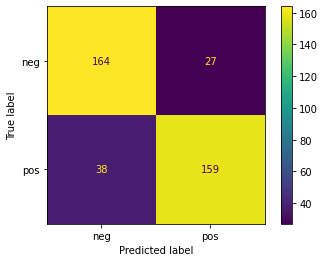
#CODE HEREfrom sklearn.metrics import classification_report,plot_confusion_matrixpreds = pipe.predict(X_test)print(classification_report(y_test,preds)) precision recall f1-score support
neg 0.81 0.86 0.83 191
pos 0.85 0.81 0.83 197
plot_confusion_matrix(pipe,X_test,y_test)<sklearn.metrics._plot.confusion_matrix.ConfusionMatrixDisplay at 0x1f370d0b790>