 ++++
++++Notebook converted from Jupyter for blog publishing.
01-Distribution-Plots

Distributions
There are many ways to display the distributions of a feature. In this notebook we explore 3 related plots for displaying a distribution, the rugplot , the distplot (histogram), and kdeplot.
IMPORTANT NOTE!
DO NOT WORRY IF YOUR PLOTS STYLING APPEARS SLIGHTLY DIFFERENT, WE WILL SHOW YOU HOW TO EDIT THE COLOR AND STYLE OF THE PLOTS LATER ON!
Data
We'll use some generated data from: http://roycekimmons.com/tools/generated_data (opens in a new tab)
import numpy as np
import pandas as pd
import matplotlib.pyplot as plt
import seaborn as sns
df = pd.read_csv("dm_office_sales.csv")df.head()division
level of education
training level
work experience
salarydf.info()<class 'pandas.core.frame.DataFrame'>
RangeIndex: 1000 entries, 0 to 999
Data columns (total 6 columns):
# Column Non-Null Count Dtype
--- ------ -------------- ----- Rugplot
Very simple plot that puts down one mark per data point. This plot needs the single array passed in directly. We won't use it too much since its not very clarifying for large data sets.
import seaborn as sns# The y axis doesn't really represent anything
# X axis is just a stick per data point
sns.rugplot(x='salary',data=df)<AxesSubplot:xlabel='salary'>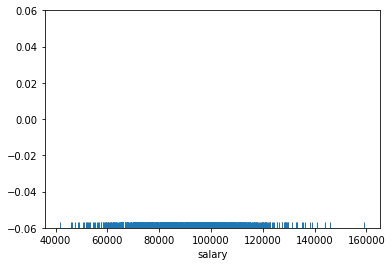
sns.rugplot(x='salary',data=df,height=0.5)<AxesSubplot:xlabel='salary'>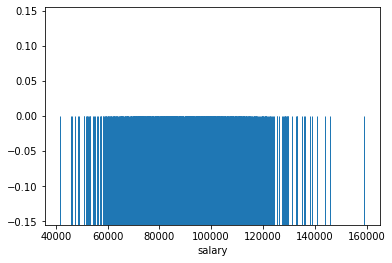
displot() and histplot()
The rugplot itself is not very informative for larger data sets distribution around the mean since so many ticks makes it hard to distinguish one tick from another. Instead we should count the number of tick marks per some segment of the x axis, then construct a histogram from this.
The displot is a plot type that can show you the distribution of a single feature. It is a histogram with the option of adding a "KDE" plot (Kernel Density Estimation) on top of the histogram. Let's explore its use cases and syntax.
sns.displot(data=df,x='salary',kde=True)<seaborn.axisgrid.FacetGrid at 0x26e5cd14cc8>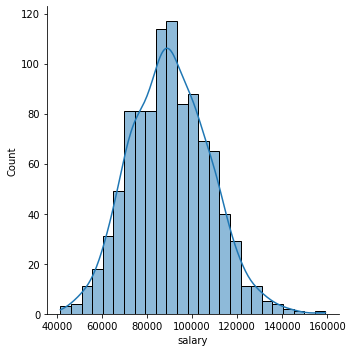
Focusing on the Histogram
sns.displot(data=df,x='salary')<seaborn.axisgrid.FacetGrid at 0x26e5ce18748>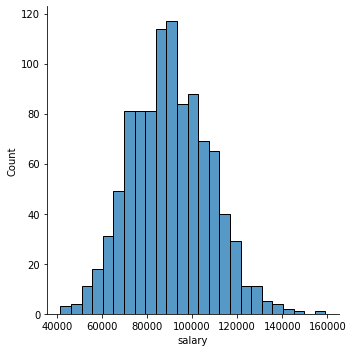
sns.histplot(data=df,x='salary')<AxesSubplot:xlabel='salary', ylabel='Count'>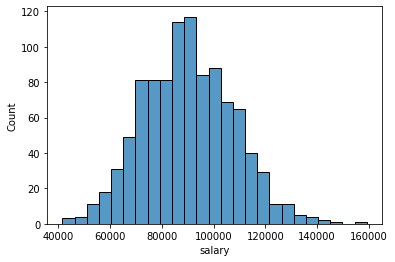
Number of Bins
sns.histplot(data=df,x='salary',bins=10)<AxesSubplot:xlabel='salary', ylabel='Count'>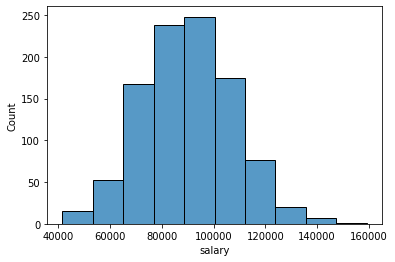
sns.histplot(data=df,x='salary',bins=100)<AxesSubplot:xlabel='salary', ylabel='Count'>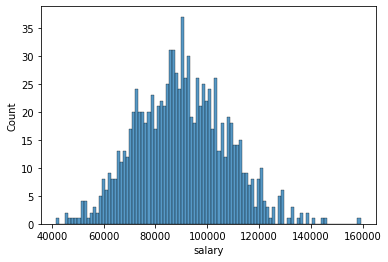
Adding in a grid and styles
You can reset to a different default style: one of {darkgrid, whitegrid, dark, white, ticks}.
In a later notebook and lecture we will cover custom styling in a lot more detail.
sns.set(style='darkgrid')
sns.histplot(data=df,x='salary',bins=100)<AxesSubplot:xlabel='salary', ylabel='Count'>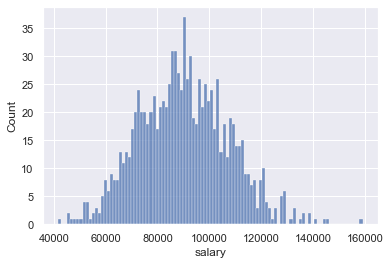
sns.set(style='white')
sns.histplot(data=df,x='salary',bins=100)<AxesSubplot:xlabel='salary', ylabel='Count'>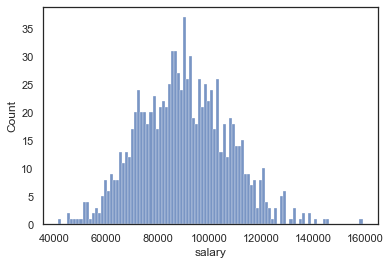
Adding in keywords from matplotlib
Seaborn plots can accept keyword arguments directly from the matplotlib code that seaborn uses. Keep in mind, not every seaborn plot can accept all matplotlib arguments, but the main styling parameters we've discussed are available.
sns.displot(data=df,x='salary',bins=20,kde=False,
color='red',edgecolor='black',lw=4,ls='--')<seaborn.axisgrid.FacetGrid at 0x26e5d449f48>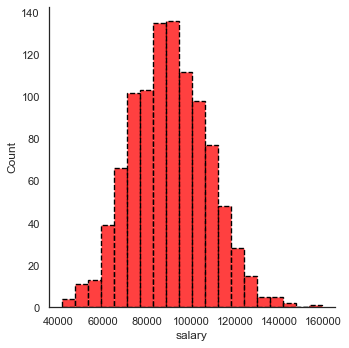
The Kernel Density Estimation Plot
Note: Review the video for full detailed explanation.
The KDE plot maps an estimate of a probability density function of a random variable. Kernel density estimation is a fundamental data smoothing problem where inferences about the population are made, based on a finite data sample.
Let's build out a simple example:
import numpy as npnp.random.seed(42)
# randint should be uniform, each age has the same chance of being chosen
# note: in reality ages are almost never uniformally distributed, but this is just an example
sample_ages = np.random.randint(0,100,200)sample_agesarray([51, 92, 14, 71, 60, 20, 82, 86, 74, 74, 87, 99, 23, 2, 21, 52, 1,
87, 29, 37, 1, 63, 59, 20, 32, 75, 57, 21, 88, 48, 90, 58, 41, 91,
59, 79, 14, 61, 61, 46, 61, 50, 54, 63, 2, 50, 6, 20, 72, 38, 17,
3, 88, 59, 13, 8, 89, 52, 1, 83, 91, 59, 70, 43, 7, 46, 34, 77,
80, 35, 49, 3, 1, 5, 53, 3, 53, 92, 62, 17, 89, 43, 33, 73, 61,sample_ages = pd.DataFrame(sample_ages,columns=["age"])sample_ages.head()age
0
51
1
92sns.rugplot(data=sample_ages,x='age')<AxesSubplot:xlabel='age'>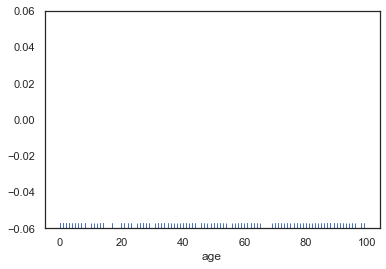
plt.figure(figsize=(12,8))
sns.displot(data=sample_ages,x='age',bins=10,rug=True)<seaborn.axisgrid.FacetGrid at 0x26e5ec12688><Figure size 864x576 with 0 Axes>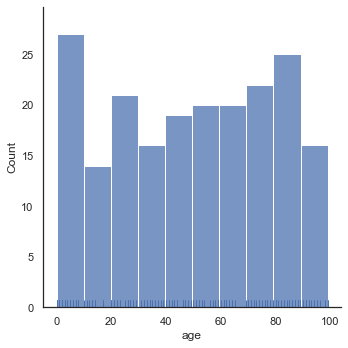
plt.figure(figsize=(12,8))
sns.displot(data=sample_ages,x='age',bins=10,rug=True,kde=True)<seaborn.axisgrid.FacetGrid at 0x26e5ec41f08><Figure size 864x576 with 0 Axes>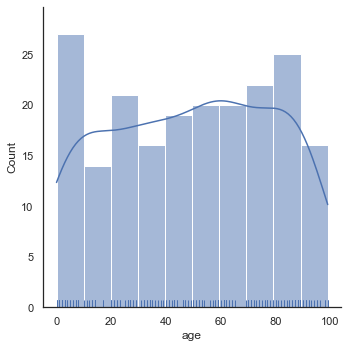
sns.kdeplot(data=sample_ages,x='age')<AxesSubplot:xlabel='age', ylabel='Density'>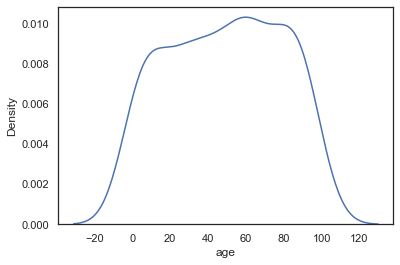
Cut Off KDE
We could cut off the KDE if we know our data has hard limits (no one can be a negative age and no one in the population can be older than 100 for some reason)
# plt.figure(figsize=(12,8))
sns.kdeplot(data=sample_ages,x='age',clip=[0,100])<AxesSubplot:xlabel='age', ylabel='Density'>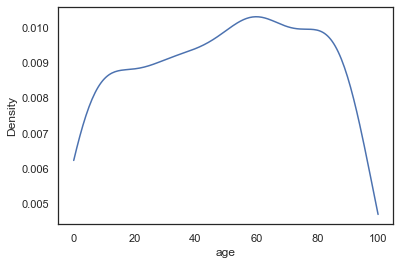
Bandwidth
As explained in the video, the KDE is constructed through the summation of the kernel (most commonly Gaussian), we can effect the bandwith of this kernel to make the KDE more "sensitive" to the data. Notice how with a smaller bandwith, the kernels don't stretch so wide, meaning we don't need the cut-off anymore. This is analagous to increasing the number of bins in a histogram (making the actual bins narrower).
sns.kdeplot(data=sample_ages,x='age',bw_adjust=0.1)<AxesSubplot:xlabel='age', ylabel='Density'>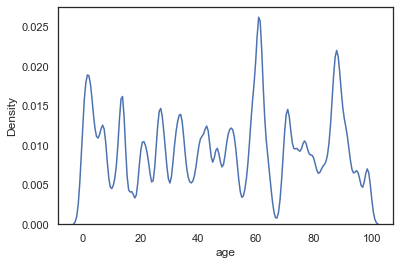
sns.kdeplot(data=sample_ages,x='age',bw_adjust=0.5)<AxesSubplot:xlabel='age', ylabel='Density'>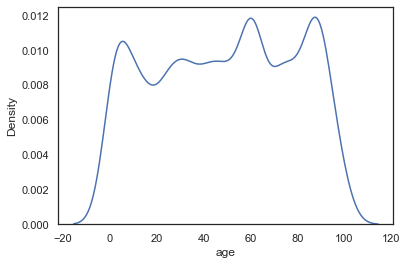
sns.kdeplot(data=sample_ages,x='age',bw_adjust=1)<AxesSubplot:xlabel='age', ylabel='Density'>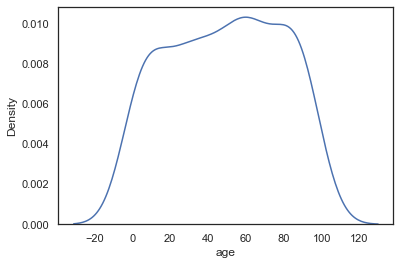
Basic Styling
There are a few basic styling calls directly availble in a KDE.
sns.kdeplot(data=sample_ages,x='age',bw_adjust=0.5,shade=True,color='red')<AxesSubplot:xlabel='age', ylabel='Density'>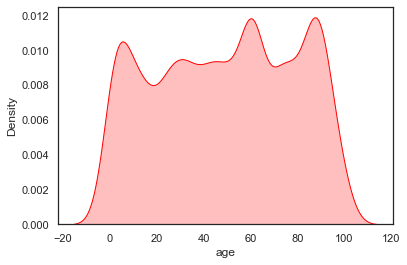
2 Dimensional KDE Plots
We will cover these in more detail later, but just keep in mind you could compare two continuous features and create a 2d KDE plot showing there distributions with the same kdeplot() call. Don't worry about this now, since we will cover it in more detail later when we talk about comparing 2 features against each other in a plot call.
random_data = pd.DataFrame(np.random.normal(0,1,size=(100,2)),columns=['x','y'])random_datax
y
0
-1.415371
-0.420645sns.kdeplot(data=random_data,x='x',y='y')<AxesSubplot:xlabel='x', ylabel='y'>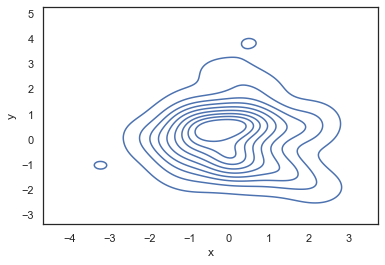
Bonus Code for Visualizations from Video Lecture
Below is the code used to create the visualizations shown in the video lecture for an explanation of a KDE plot. We will not cover this code in further detail, since it was only used for the creation of the slides shown in the video.
from scipy import statsData
np.random.seed(101)
x = np.random.normal(0, 1, size=20)plt.figure(figsize=(8,4),dpi=200)
sns.rugplot(x, color="darkblue", linewidth=4)<AxesSubplot:>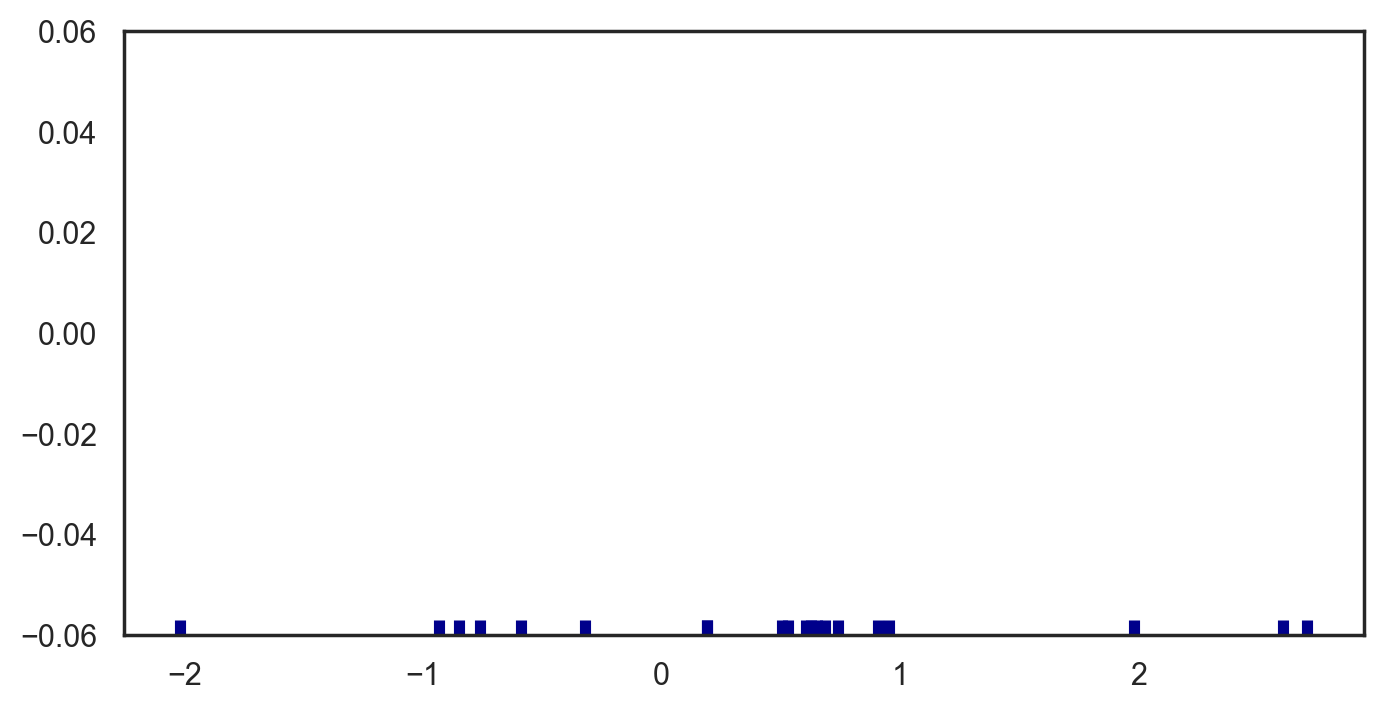
plt.figure(figsize=(8,4),dpi=200)
bandwidth = x.std() * x.size ** (-0.001)
support = np.linspace(-5, 5, 100)

kernels = []

plt.figure(figsize=(12,6))

for x_i in x:

    kernel = stats.norm(x_i, bandwidth).pdf(support)
    kernels.append(kernel)
    plt.plot(support, kernel, color="lightblue")

sns.rugplot(x, color="darkblue", linewidth=4);<Figure size 1600x800 with 0 Axes>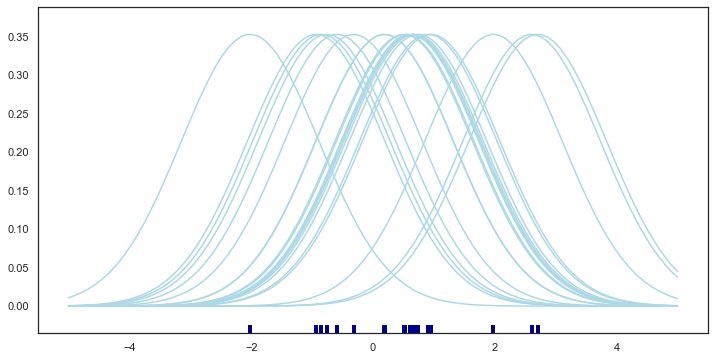
plt.figure(figsize=(8,4),dpi=200)
from scipy.integrate import trapz
plt.figure(figsize=(12,6))
density = np.sum(kernels, axis=0)
density /= trapz(density, support)
plt.plot(support, density);
sns.rugplot(x, color="darkblue", linewidth=4);<Figure size 1600x800 with 0 Axes>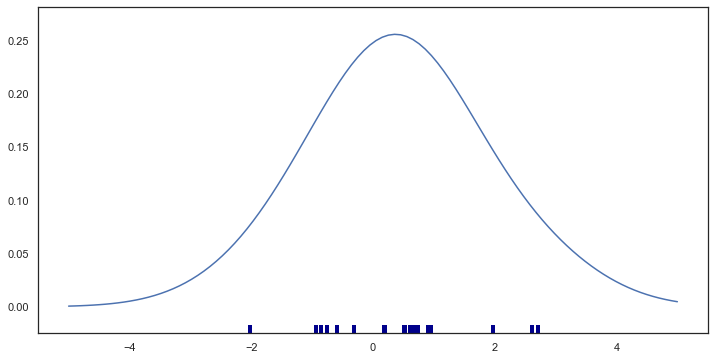
plt.figure(figsize=(8,4),dpi=200)
bandwidth = x.std() * x.size ** (-0.001)
support = np.linspace(-5, 5, 100)

kernels = []

plt.figure(figsize=(12,6))

for x_i in x:

    kernel = stats.norm(x_i, bandwidth).pdf(support)
    kernels.append(kernel)
#     plt.plot(support, kernel, color="lightblue")

# sns.rugplot(x, color="darkblue", linewidth=4);
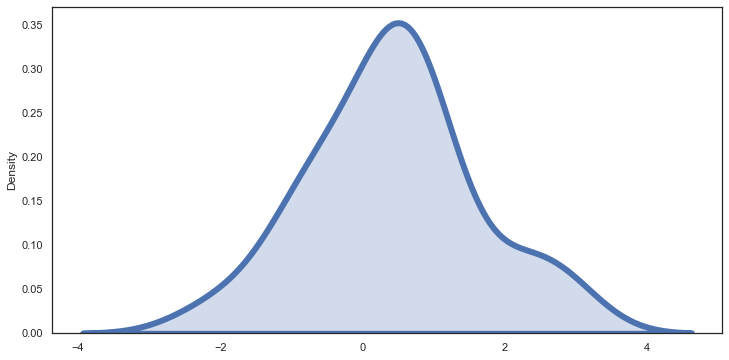
sns.kdeplot(x,linewidth=6,shade=True)<AxesSubplot:ylabel='Density'><Figure size 1600x800 with 0 Axes>