 ++++
++++Notebook converted from Jupyter for blog publishing.
02-NumPy-Operations

NumPy Operations
Arithmetic
You can easily perform array with array arithmetic, or scalar with array arithmetic. Let's see some examples:
import numpy as np
arr = np.arange(0,10)
arrarray([0, 1, 2, 3, 4, 5, 6, 7, 8, 9])arr + arrarray([ 0, 2, 4, 6, 8, 10, 12, 14, 16, 18])arr * arrarray([ 0, 1, 4, 9, 16, 25, 36, 49, 64, 81])arr - arrarray([0, 0, 0, 0, 0, 0, 0, 0, 0, 0])# This will raise a Warning on division by zero, but not an error!
# It just fills the spot with nan
arr/arrC:\Anaconda3\envs\tsa_course\lib\site-packages\ipykernel_launcher.py:3: RuntimeWarning: invalid value encountered in true_divide
This is separate from the ipykernel package so we can avoid doing imports untilarray([nan, 1., 1., 1., 1., 1., 1., 1., 1., 1.])# Also a warning (but not an error) relating to infinity
1/arrC:\Anaconda3\envs\ sa_course\lib\site-packages\ipykernel_launcher.py:2: RuntimeWarning: divide by zero encountered in true_dividearray([ inf, 1. , 0.5 , 0.33333333, 0.25 ,
0.2 , 0.16666667, 0.14285714, 0.125 , 0.11111111])arr**3array([ 0, 1, 8, 27, 64, 125, 216, 343, 512, 729], dtype=int32)Universal Array Functions
NumPy comes with many universal array functions (opens in a new tab), or ufuncs, which are essentially just mathematical operations that can be applied across the array.
Let's show some common ones:
# Taking Square Roots
np.sqrt(arr)array([0. , 1. , 1.41421356, 1.73205081, 2. ,
2.23606798, 2.44948974, 2.64575131, 2.82842712, 3. ])# Calculating exponential (e^)
np.exp(arr)array([1.00000000e+00, 2.71828183e+00, 7.38905610e+00, 2.00855369e+01,
5.45981500e+01, 1.48413159e+02, 4.03428793e+02, 1.09663316e+03,
2.98095799e+03, 8.10308393e+03])# Trigonometric Functions like sine
np.sin(arr)array([ 0. , 0.84147098, 0.90929743, 0.14112001, -0.7568025 ,
-0.95892427, -0.2794155 , 0.6569866 , 0.98935825, 0.41211849])# Taking the Natural Logarithm
np.log(arr)C:\Anaconda3\envs\ sa_course\lib\site-packages\ipykernel_launcher.py:2: RuntimeWarning: divide by zero encountered in logarray([ -inf, 0. , 0.69314718, 1.09861229, 1.38629436,
1.60943791, 1.79175947, 1.94591015, 2.07944154, 2.19722458])Summary Statistics on Arrays
NumPy also offers common summary statistics like sum, mean and max. You would call these as methods on an array.
arr = np.arange(0,10)
arrarray([0, 1, 2, 3, 4, 5, 6, 7, 8, 9])arr.sum()45arr.mean()4.5arr.max()9arr.min() returns 0 minimum arr.var() returns 8.25 variance arr.std() returns 2.8722813232690143 standard deviation
Axis Logic
When working with 2-dimensional arrays (matrices) we have to consider rows and columns. This becomes very important when we get to the section on pandas. In array terms, axis 0 (zero) is the vertical axis (rows), and axis 1 is the horizonal axis (columns). These values (0,1) correspond to the order in which arr.shape values are returned.
Let's see how this affects our summary statistic calculations from above.
arr_2d = np.array([[1,2,3,4],[5,6,7,8],[9,10,11,12]])
arr_2darray([[ 1, 2, 3, 4],
[ 5, 6, 7, 8],
[ 9, 10, 11, 12]])arr_2d.sum(axis=0)array([15, 18, 21, 24])By passing in axis=0, we're returning an array of sums along the vertical axis, essentially [(1+5+9), (2+6+10), (3+7+11), (4+8+12)]
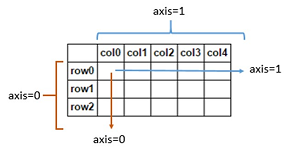
arr_2d.shape(3, 4)This tells us that arr_2d has 3 rows and 4 columns.
In arr_2d.sum(axis=0) above, the first element in each row was summed, then the second element, and so forth.
So what should arr_2d.sum(axis=1) return?
# THINK ABOUT WHAT THIS WILL RETURN BEFORE RUNNING THE CELL!
arr_2d.sum(axis=1)
Great Job!
That's all we need to know for now!