Adapted from Prompting Guide: Reflexion — https://www.promptingguide.ai/techniques/reflexion
Introduction
Standard language agents often struggle to improve their performance without extensive retraining. Reflexion, proposed by Shinn et al. (2023), is a new paradigm for "verbal" reinforcement that parameterizes a policy as an agent's memory encoding.
At a high level, Reflexion converts environmental feedback into linguistic feedback—self-reflection—which is then provided as context for the agent in its next attempt.
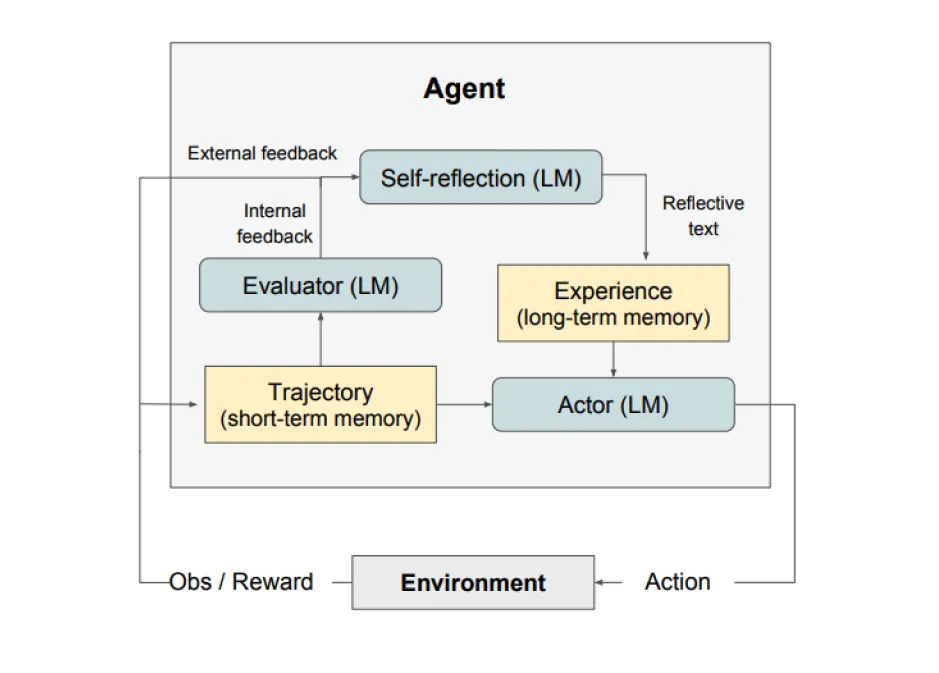
Image Source: Shinn et al. (2023)
The Tripartite Architecture
Reflexion consists of three distinct models working in tandem:
- The Actor: Generates text and actions based on observations. Core models like Chain-of-Thought (CoT) or ReAct serve as the Actor.
- The Evaluator: Scores the Actor's outputs by taking a generated trajectory and outputting a reward score (binary or scalar).
- Self-Reflection: An LLM that generates verbal reinforcement cues based on the reward signal, current trajectory, and persistent memory.
How Reflexion Learns
The Reflexion process follows a cyclical, iterative path:
- Define Task → Generate Trajectory → Evaluate → Reflect → Repeat.
This feedback loop allows the agent to rapidly and effectively learn from prior mistakes, leading to state-of-the-art performance on various complex tasks.
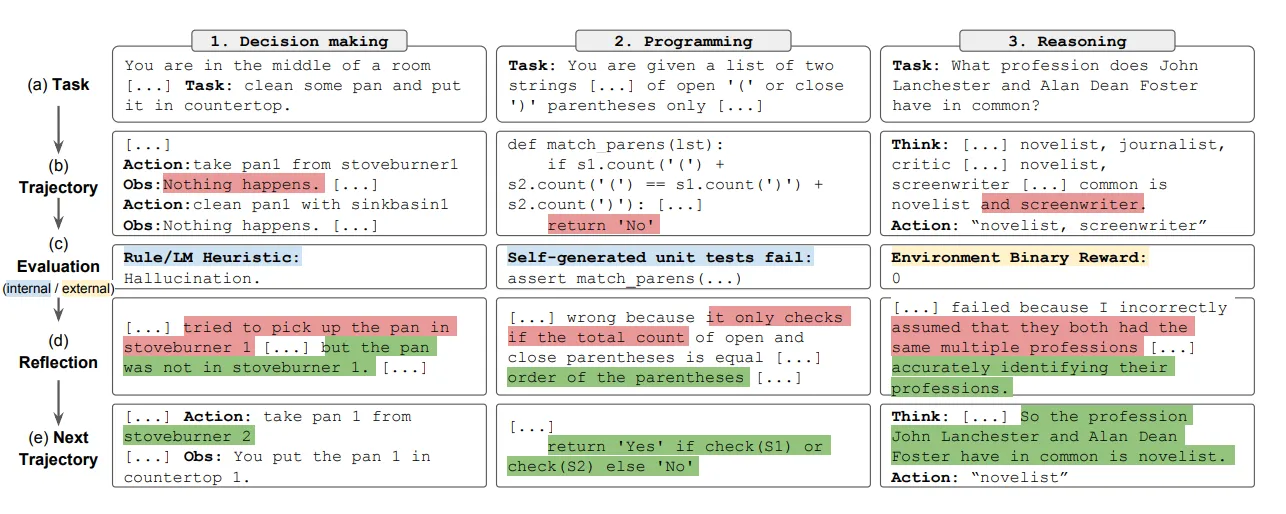
Image Source: Shinn et al. (2023)
Research Results
Experimental results show that Reflexion agents significantly outperform traditional few-shot and CoT baselines across decision-making, reasoning, and programming tasks.
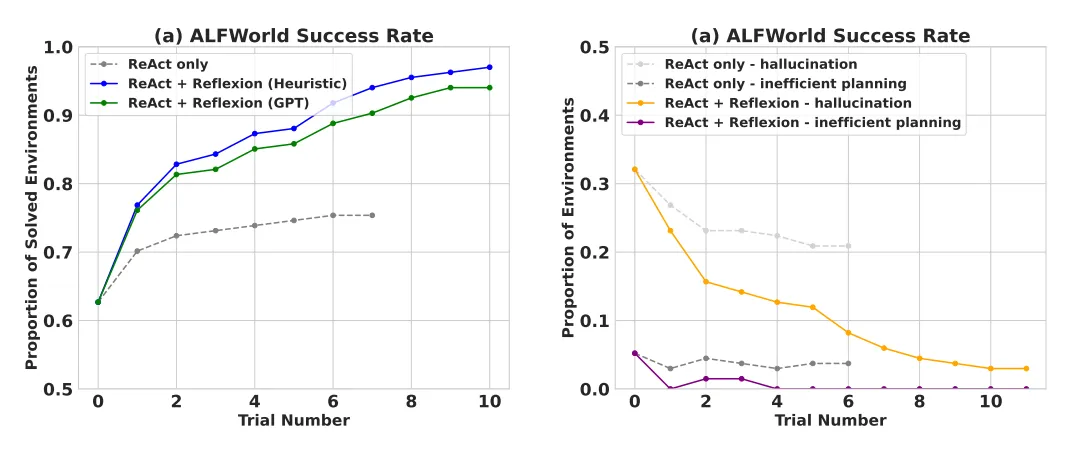
Sequential Decision-Making (ALFWorld)
On ALFWorld tasks, ReAct + Reflexion completed 130 out of 134 tasks, significantly outperforming standalone ReAct.
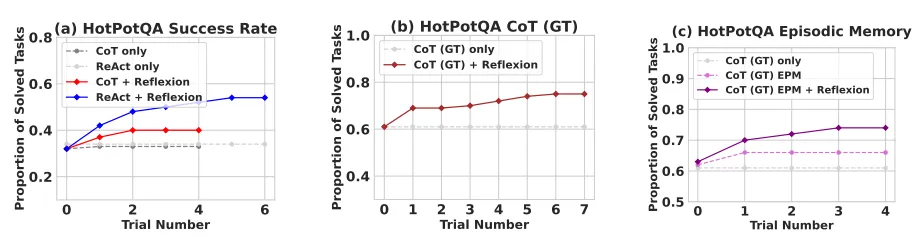
Complex Reasoning (HotPotQA)
Reflexion + CoT consistently outperforms CoT only and CoT with episodic memory by leveraging persistent self-reflection.
Programming (HumanEval & MBPP)
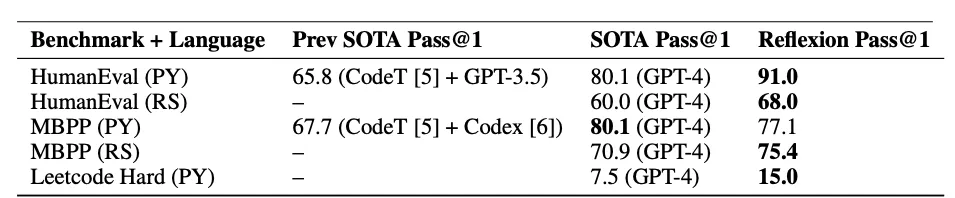
Reflexion achieved state-of-the-art results on Python and Rust code writing benchmarks, outperforming previous SOTA approaches on HumanEval.
When to Use Reflexion?
Reflexion is best suited for scenarios where:
- Trial and Error is Necessary: Environments like ALFWorld or WebShop.
- Fine-tuning is Impractical: High compute costs or limited training data.
- Nuanced Feedback is Required: Verbal feedback is more specific than scalar rewards.
- Interpretability is Key: Self-reflections are stored in explicit memory, making the learning process human-readable.
Limitations: Reflexion relies heavily on the agent's ability to accurately self-evaluate. For extremely complex tasks, persistent memory may require more advanced structures like vector databases or SQL.
Reflexion is a major step toward autonomous systems that can debug themselves. To see how these self-correcting loops can be applied to multi-modal reasoning, explore Multimodal CoT next.