Adapted from Prompting Guide: Chain-of-Thought Prompting — https://www.promptingguide.ai/techniques/cot
Chain-of-Thought (CoT) Prompting
Introduced in Wei et al. (2022), chain-of-thought (CoT) prompting enables complex reasoning capabilities through intermediate reasoning steps. You can combine it with few-shot prompting to get better results on more complex tasks that require reasoning before responding.
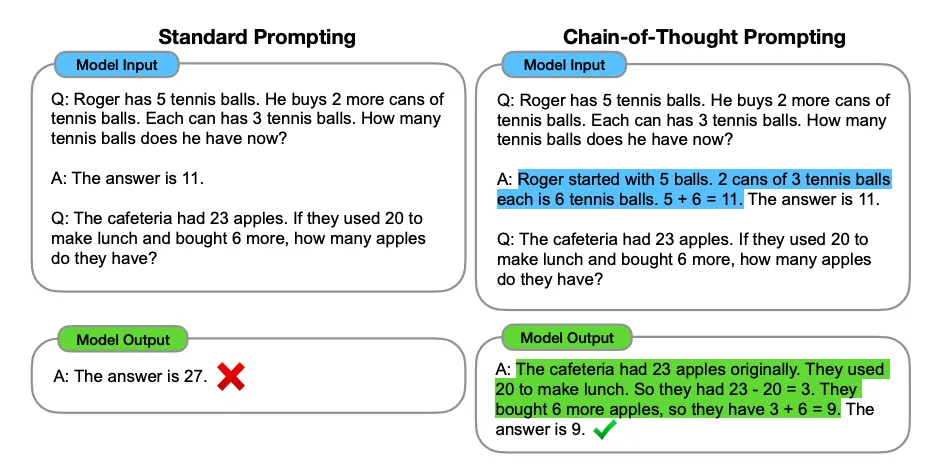
CoT in Action: Reasoning via Examples
In the following example, we provide the model with several demonstrations of how to solve the problem, rather than just the final answer.
Prompt (4-Shot CoT):
The odd numbers in this group add up to an even number: 4, 8, 9, 15, 12, 2, 1.
A: Adding all the odd numbers (9, 15, 1) gives 25. The answer is False.
The odd numbers in this group add up to an even number: 17, 10, 19, 4, 8, 12, 24.
A: Adding all the odd numbers (17, 19) gives 36. The answer is True.
The odd numbers in this group add up to an even number: 16, 11, 14, 4, 8, 13, 24.
A: Adding all the odd numbers (11, 13) gives 24. The answer is True.
The odd numbers in this group add up to an even number: 17, 9, 10, 12, 13, 4, 2.
A: Adding all the odd numbers (17, 9, 13) gives 39. The answer is False.
The odd numbers in this group add up to an even number: 15, 32, 5, 13, 82, 7, 1.
A:
Output:
Adding all the odd numbers (15, 5, 13, 7, 1) gives 41. The answer is False.Wow! We can see a perfect result when we provided the reasoning step. In fact, providing even fewer examples (1-shot) is often enough for modern models to pick up the pattern.
Zero-Shot CoT Prompting
Research by Kojima et al. (2022) discovered that you can trigger CoT reasoning without manual examples by adding the phrase "Let's think step by step" to the original prompt.
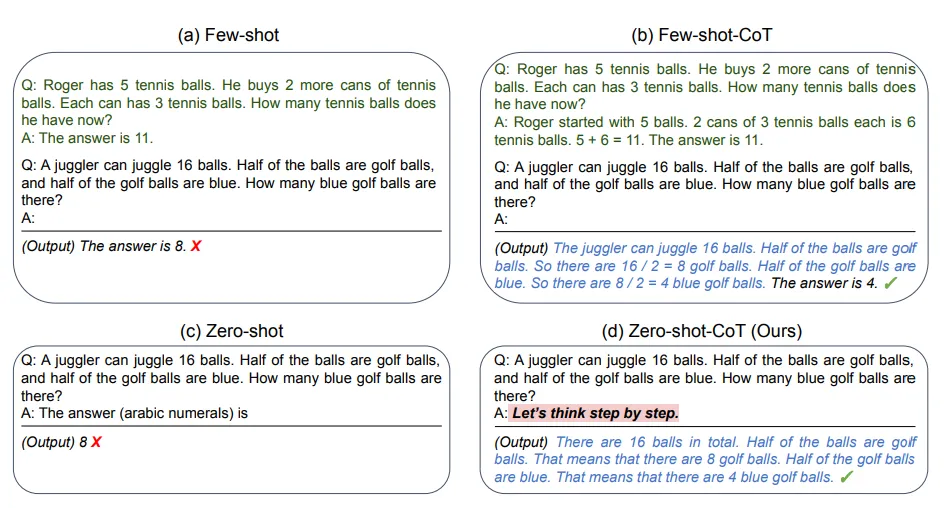
"Market & Apples" Comparison
Prompt (Standard):
"I went to the market and bought 10 apples. I gave 2 apples to the neighbor and 2 to the repairman. I then went and bought 5 more apples and ate 1. How many apples did I remain with?"
Output: 11 apples (Incorrect)Prompt (Zero-Shot CoT):
"I went to the market and bought 10 apples. I gave 2 apples to the neighbor and 2 to the repairman. I then went and bought 5 more apples and ate 1. How many apples did I remain with? Let's think step by step."
Output:
First, you started with 10 apples. You gave away 2 apples to the neighbor and 2 to the repairman, so you had 6 apples left. Then you bought 5 more apples, so now you had 11 apples. Finally, you ate 1 apple, so you would remain with 10 apples. (Correct)Automatic Chain-of-Thought (Auto-CoT)
When applying CoT with demonstrations, researchers noticed that hand-crafting diverse examples is often a bottleneck and could lead to suboptimal solutions. Zhang et al. (2022) proposed Auto-CoT to eliminate manual effort by leveraging LLMs to generate reasoning chains for demonstrations.
Auto-CoT consists of two main stages:
- Question Clustering: Partitioning the dataset questions into several distinct clusters.
- Demonstration Sampling: Selecting a representative question from each cluster and generating its reasoning chain via Zero-Shot CoT with simple heuristics.
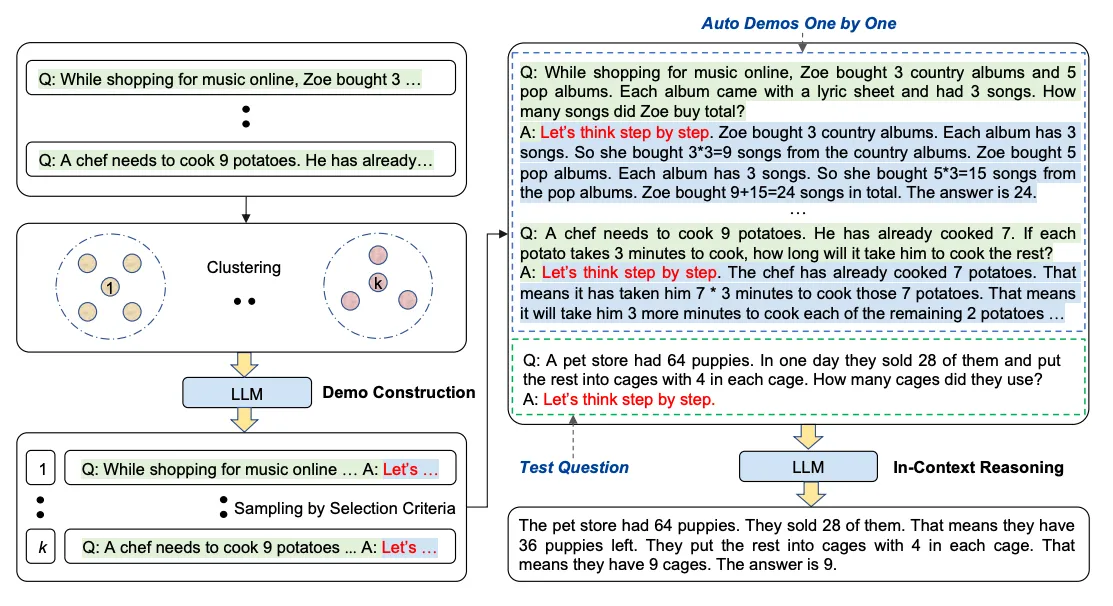
The simple heuristics, such as question length (e.g., 60 tokens) and number of rationale steps (e.g., 5 steps), encourage the model to use simple and accurate demonstrations.
The source code for Auto-CoT is available on GitHub.
Why CoT Matters
CoT is an emergent ability. It typically only appears in models of a certain scale (e.g., ~175B parameters or larger). For smaller models, adding intermediate steps can actually decrease performance by introducing more tokens for the model to hallucinate or drift away from the core task.