Networking Basics & IP Addresses
Networking is the backbone of any distributed system. Every system relies on data exchange between components to enable scalability, reliability, and performance.
Why Networking Matters in System Design?
Key areas where networking plays a crucial role:
- Communication: Ensuring smooth data transfer between clients, servers, and databases.
- Load Balancing: Distributing traffic efficiently to prevent overload on a single server.
- Security: Protecting data from unauthorized access and cyber threats.
- Efficiency: Optimizing network performance to reduce latency.
Introduction to IP Addresses
IP (Internet Protocol) addresses are unique numerical labels assigned to devices on a network. They enable communication across the internet.
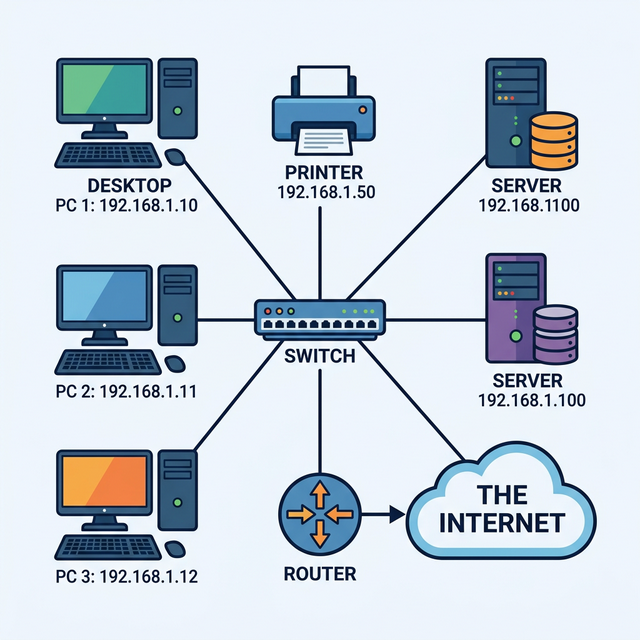
IPv4 vs IPv6
- IPv4: 32-bit format (e.g.,
192.168.1.1). Limited to ~4.3 billion addresses. - Designed for: IoT, mobile networks, and future scalability (340 undecillion addresses).

Private vs. Public IPs
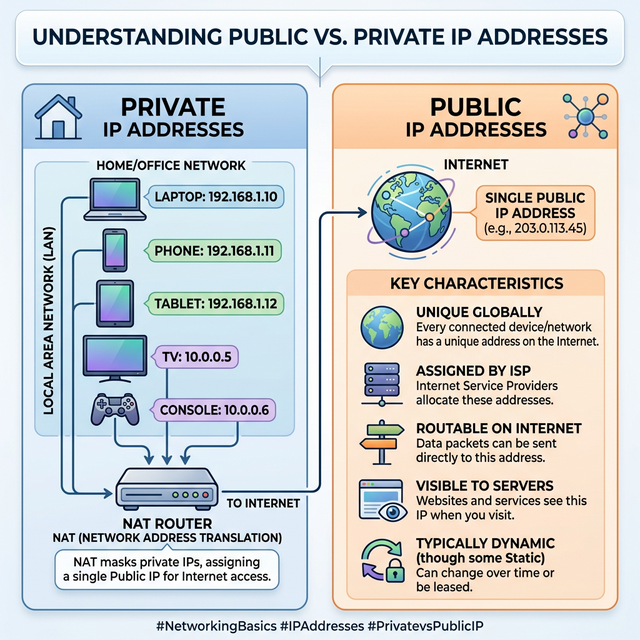
- Public IPs: Assigned by ISPs, used to communicate over the global internet. Unique worldwide.
- Private IPs: Used within local networks (LANs). Cannot be accessed directly from the internet.
Why Do We Need Private IPs?
- Conserve Public IPs: Allows millions of devices to share a few public IPs.
- Security: Private IPs are not routable over the internet.
- NAT (Network Address Translation): Enables multiple devices in a private network to share a single public IP.

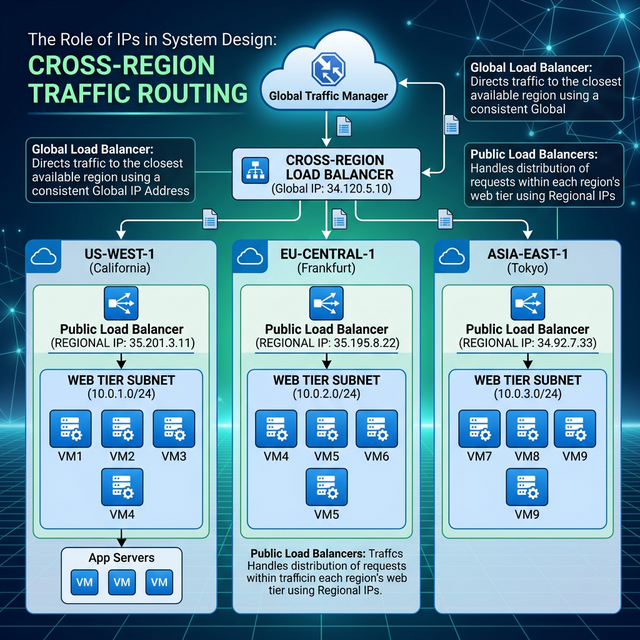
The Role of IPs in System Design
IP addresses are foundational to building robust architectures:
- Scalability: Multi-region and cloud-based deployments.
- Anycast IPs: Directing users to the nearest healthy server.
- VPC Networking: Isolating microservices using internal private IPs.