Text Classification Assessment - Solution
Goal: Given a set of text movie reviews that have been labeled negative or positive
For more information on this dataset visit http://ai.stanford.edu/~amaas/data/sentiment/
Complete the tasks in bold below!
Task: Perform imports and load the dataset into a pandas DataFrame For this exercise you can load the dataset from '../DATA/moviereviews.csv'{:python}.
# CODE HEREdf = pd.read_csv('../DATA/moviereviews.csv')df.head()label
review
0
neg
how do films like mouse hunt get into theatres...12 more lines
1
neg
some talented actresses are blessed with a dem...
2
pos
this has been an extraordinary year for austra...
3
pos
according to hollywood movies made in last few...
4
neg
my first press screening of 1998 and already i...
TASK: Check to see if there are any missing values in the dataframe.
#CODE HERE# Check for NaN values:
df.isnull().sum()label 0
review 35
dtype: int64TASK: Remove any reviews that are NaN
df = df.dropna()TASK: Check to see if any reviews are blank strings and not just NaN. Note: This means a review text could just be: "" or " " or some other larger blank string. How would you check for this? Note: There are many ways! Once you've discovered the reviews that are blank strings, go ahead and remove them as well. Click me for a big hint
df['review'].str.isspace().sum()27df[df['review'].str.isspace()]label
review
57
neg
7151 more lines
pos
147
pos
151
pos
283
pos
307
pos
313
neg
323
pos
343
pos
351
neg
427
pos
501
neg
633
pos
675
neg
815
neg
851
neg
977
neg
1079
neg
1299
pos
1455
neg
1493
pos
1525
neg
1531
neg
1763
neg
1851
neg
1905
pos
1993
posdf = df[~df['review'].str.isspace()]df.info()<class 'pandas.core.frame.DataFrame'>
Int64Index: 1938 entries, 0 to 1999
Data columns (total 2 columns):
# Column Non-Null Count Dtype
--- ------ -------------- ----- 4 more lines
 0   label   1938 non-null   object
 1   review  1938 non-null   object
dtypes: object(2)
memory usage: 45.4+ KB
TASK: Confirm the value counts per label:
#CODE HEREdf['label'].value_counts()pos 969
neg 969
Name: label, dtype: int64EDA on Bag of Words
Bonus Task: Can you figure out how to use a CountVectorizer model to get the top 20 words (that are not english stop words) per label type? Note, this is a bonus task as we did not show this in the lectures. But a quick cursory Google search should put you on the right path. Click me for a big hint
from sklearn.feature_extraction.text import CountVectorizercv = CountVectorizer(stop_words='english')matrix = cv.fit_transform(df[df['label']=='neg']['review'])
freqs = zip(cv.get_feature_names(), matrix.sum(axis=0).tolist()[0])
# sort from largest to smallest
print("Top 20 words used for Negative reviews.")
print(sorted(freqs, key=lambda x: -x[1])[:20])Top 20 words used for Negative reviews.
[('film', 4063), ('movie', 3131), ('like', 1808), ('just', 1480), ('time', 1127), ('good', 1117), ('bad', 997), ('character', 926), ('story', 908), ('plot', 888), ('characters', 838), ('make', 813), ('really', 743), ('way', 734), ('little', 696), ('don', 683), ('does', 666), ('doesn', 648), ('action', 635), ('scene', 634)]matrix = cv.fit_transform(df[df['label']=='pos']['review'])
freqs = zip(cv.get_feature_names(), matrix.sum(axis=0).tolist()[0])
# sort from largest to smallest
print("Top 20 words used for Positive reviews.")
print(sorted(freqs, key=lambda x: -x[1])[:20])Top 20 words used for Positive reviews.
[('film', 5002), ('movie', 2389), ('like', 1721), ('just', 1273), ('story', 1199), ('good', 1193), ('time', 1175), ('character', 1037), ('life', 1032), ('characters', 957), ('way', 864), ('films', 851), ('does', 828), ('best', 788), ('people', 769), ('make', 764), ('little', 751), ('really', 731), ('man', 728), ('new', 702)]Training and Data
TASK: Split the data into features and a label (X and y) and then preform a train/test split. You may use whatever settings you like. To compare your results to the solution notebook, use test_size=0.20, random_state=101{:python}
#CODE HEREfrom sklearn.model_selection import train_test_split
X = df['review']
y = df['label']
X_train, X_test, y_train, y_test = train_test_split(X, y, test_size=0.2, random_state=101)Training a Mode
TASK: Create a PipeLine that will both create a TF-IDF Vector out of the raw text data and fit a supervised learning model of your choice. Then fit that pipeline on the training data.
#CODE HEREfrom sklearn.pipeline import Pipeline
from sklearn.feature_extraction.text import TfidfVectorizer
from sklearn.svm import LinearSVC
from sklearn.naive_bayes import MultinomialNBpipe = Pipeline([('tfidf', TfidfVectorizer()),('svc', LinearSVC()),])# Feed the training data through the pipeline
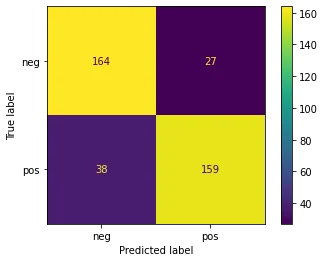
pipe.fit(X_train, y_train)Pipeline(steps=[('tfidf', TfidfVectorizer()), ('svc', LinearSVC())])TASK: Create a classification report and plot a confusion matrix based on the results of your PipeLine.
#CODE HEREfrom sklearn.metrics import classification_report,plot_confusion_matrixpreds = pipe.predict(X_test)print(classification_report(y_test,preds)) precision recall f1-score support
neg 0.81 0.86 0.83 191
pos 0.85 0.81 0.83 197
3 more lines
    accuracy                           0.83       388
   macro avg       0.83      0.83      0.83       388
weighted avg 0.83 0.83 0.83 388plot_confusion_matrix(pipe,X_test,y_test)<sklearn.metrics._plot.confusion_matrix.ConfusionMatrixDisplay at 0x1f370d0b790>