Decision Trees
The Data
We will be using the same dataset through our discussions on classification with tree-methods (Decision Tree,Random Forests, and Gradient Boosted Trees) in order to compare performance metrics across these related models.
We will work with the "Palmer Penguins" dataset, as it is simple enough to help us fully understand how changing hyperparameters can change classification results.
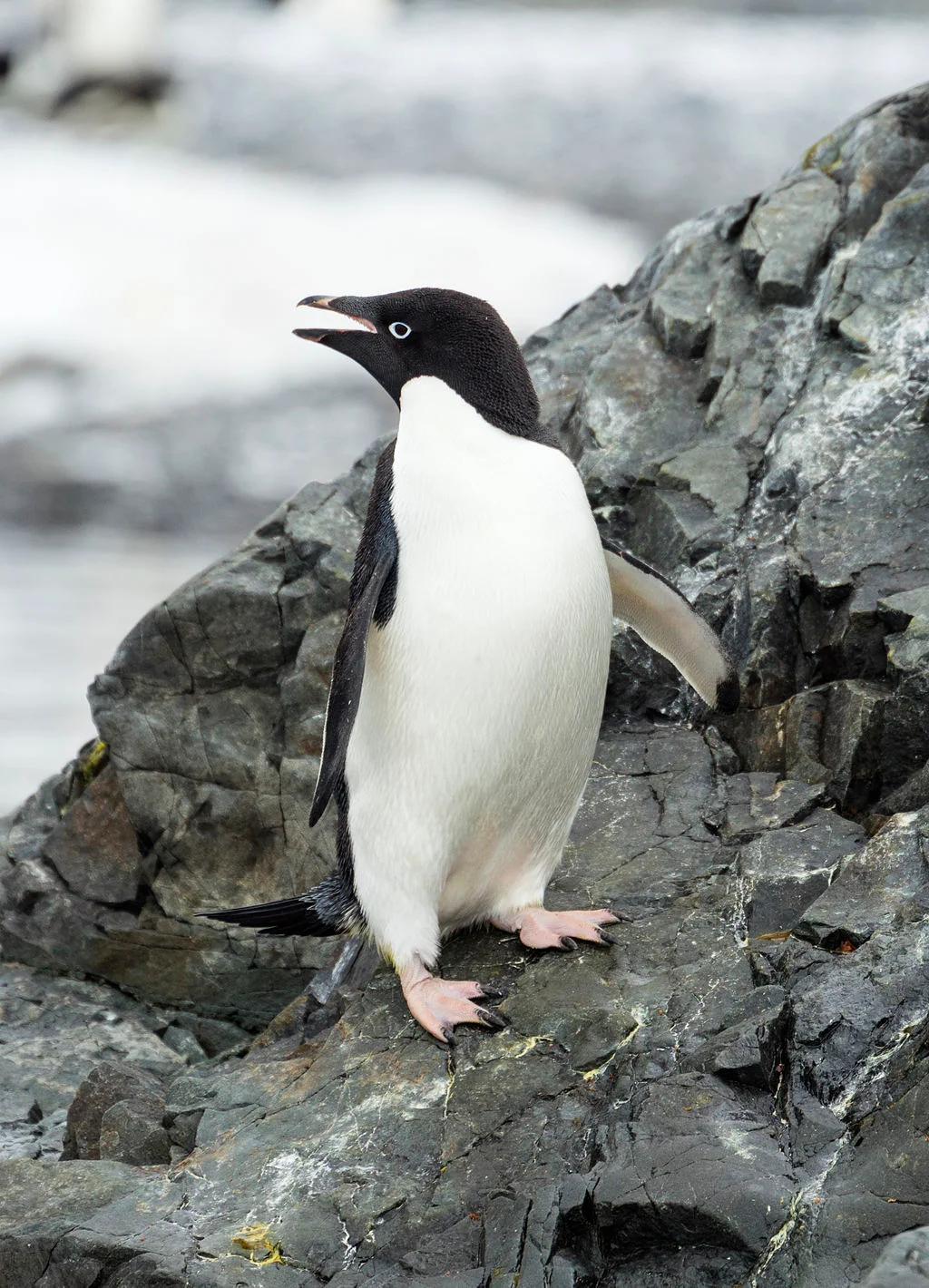
Data were collected and made available by Dr. Kristen Gorman and the Palmer Station, Antarctica LTER, a member of the Long Term Ecological Research Network.
Gorman KB, Williams TD, Fraser WR (2014) Ecological Sexual Dimorphism and Environmental Variability within a Community of Antarctic Penguins (Genus Pygoscelis). PLoS ONE 9(3): e90081. doi:10.1371/journal.pone.0090081
Summary: The data folder contains two CSV files. For intro courses/examples, you probably want to use the first one (penguins_size.csv).
- penguins_size.csv: Simplified data from original penguin data sets. Contains variables:
- species: penguin species (Chinstrap, Adélie, or Gentoo)
- culmen_length_mm: culmen length (mm)
- culmen_depth_mm: culmen depth (mm)
- flipper_length_mm: flipper length (mm)
- body_mass_g: body mass (g)
- island: island name (Dream, Torgersen, or Biscoe) in the Palmer Archipelago (Antarctica)
- sex: penguin sex
- (Not used) penguins_lter.csv: Original combined data for 3 penguin species
Note: The culmen is "the upper ridge of a bird's beak"
Our goal is to create a model that can help predict a species of a penguin based on physical attributes, then we can use that model to help researchers classify penguins in the field, instead of needing an experienced biologist
Imports
df = pd.read_csv("../DATA/penguins_size.csv")df.head()species
island
culmen_length_mm
culmen_depth_mm
flipper_length_mm42 more lines
body_mass_g
sex
0
Adelie
Torgersen
39.1
18.7
181.0
3750.0
MALE
1
Adelie
Torgersen
39.5
17.4
186.0
3800.0
FEMALE
2
Adelie
Torgersen
40.3
18.0
195.0
3250.0
FEMALE
3
Adelie
Torgersen
NaN
NaN
NaN
NaN
NaN
4
Adelie
Torgersen
36.7
19.3
193.0
3450.0
FEMALE
EDA
Missing Data
Recall the purpose is to create a model for future use, so data points missing crucial information won't help in this task, especially since for future data points we will assume the research will grab the relevant feature information.
df.info()<class 'pandas.core.frame.DataFrame'>
RangeIndex: 344 entries, 0 to 343
Data columns (total 7 columns):
# Column Non-Null Count Dtype
--- ------ -------------- ----- 9 more lines
 0   species            344 non-null    object
 1   island             344 non-null    object
 2   culmen_length_mm   342 non-null    float64
 3   culmen_depth_mm    342 non-null    float64
 4   flipper_length_mm  342 non-null    float64
 5   body_mass_g        342 non-null    float64
 6   sex                334 non-null    object
dtypes: float64(4), object(3)
memory usage: 18.9+ KBdf.isna().sum()species 0
island 0
culmen_length_mm 2
culmen_depth_mm 2
flipper_length_mm 23 more lines
body_mass_g           2
sex                  10
dtype: int64# What percentage are we dropping?
100*(10/344)2.9069767441860463df = df.dropna()df.info()<class 'pandas.core.frame.DataFrame'>
Int64Index: 334 entries, 0 to 343
Data columns (total 7 columns):
# Column Non-Null Count Dtype
--- ------ -------------- ----- 9 more lines
 0   species            334 non-null    object
 1   island             334 non-null    object
 2   culmen_length_mm   334 non-null    float64
 3   culmen_depth_mm    334 non-null    float64
 4   flipper_length_mm  334 non-null    float64
 5   body_mass_g        334 non-null    float64
 6   sex                334 non-null    object
dtypes: float64(4), object(3)
memory usage: 20.9+ KBdf.head()species
island
culmen_length_mm
culmen_depth_mm
flipper_length_mm42 more lines
body_mass_g
sex
0
Adelie
Torgersen
39.1
18.7
181.0
3750.0
MALE
1
Adelie
Torgersen
39.5
17.4
186.0
3800.0
FEMALE
2
Adelie
Torgersen
40.3
18.0
195.0
3250.0
FEMALE
4
Adelie
Torgersen
36.7
19.3
193.0
3450.0
FEMALE
5
Adelie
Torgersen
39.3
20.6
190.0
3650.0
MALEdf['sex'].unique()array(['MALE', 'FEMALE', '.'], dtype=object)df['island'].unique()array(['Torgersen', 'Biscoe', 'Dream'], dtype=object)df = df[df['sex']!='.']Visualization
sns.scatterplot(x='culmen_length_mm',y='culmen_depth_mm',data=df,hue='species',palette='Dark2')<AxesSubplot:xlabel='culmen_length_mm', ylabel='culmen_depth_mm'>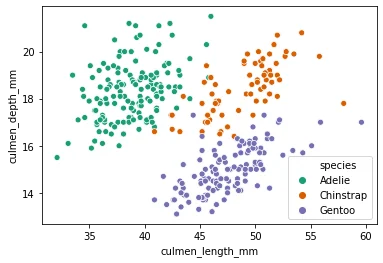
sns.pairplot(df,hue='species',palette='Dark2')<seaborn.axisgrid.PairGrid at 0x24fa25bc9c8>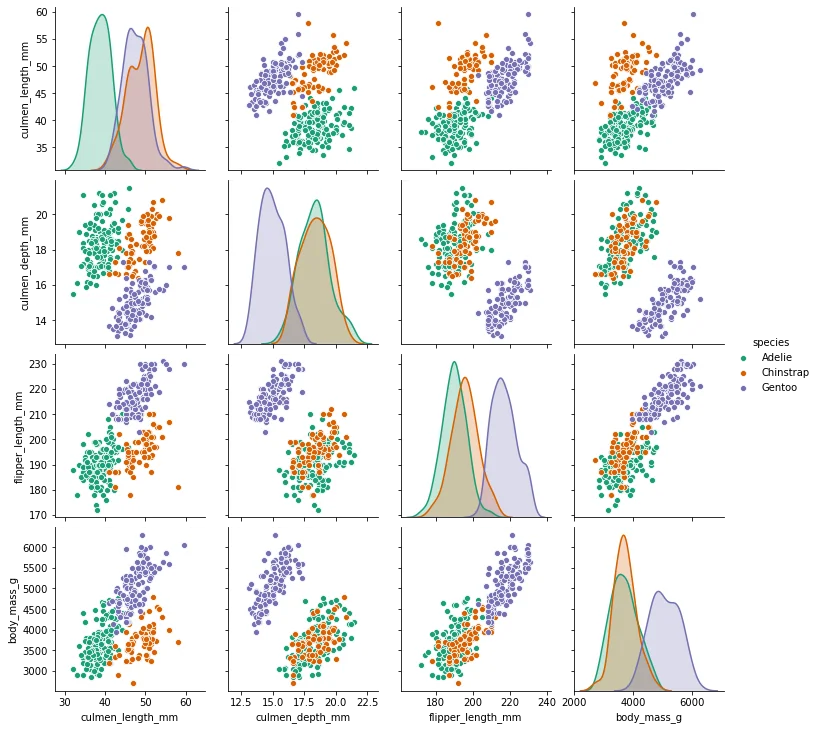
sns.catplot(x='species',y='culmen_length_mm',data=df,kind='box',col='sex',palette='Dark2')<seaborn.axisgrid.FacetGrid at 0x24fa3019ec8>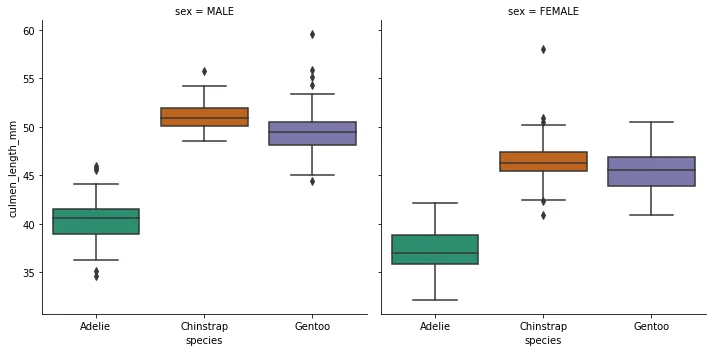
Feature Engineering
pd.get_dummies(df)culmen_length_mm
culmen_depth_mm
flipper_length_mm
body_mass_g
species_Adelie151 more lines
species_Chinstrap
species_Gentoo
island_Biscoe
island_Dream
island_Torgersen
sex_FEMALE
sex_MALE
0
39.1
18.7
181.0
3750.0
1
0
0
0
0
1
0
1
1
39.5
17.4
186.0
3800.0
1
0
0
0
0
1
1
0
2
40.3
18.0
195.0
3250.0
1
0
0
0
0
1
1
0
4
36.7
19.3
193.0
3450.0
1
0
0
0
0
1
1
0
5
39.3
20.6
190.0
3650.0
1
0
0
0
0
1
0
1
...
...
...
...
...
...
...
...
...
...
...
...
...
338
47.2
13.7
214.0
4925.0
0
0
1
1
0
0
1
0
340
46.8
14.3
215.0
4850.0
0
0
1
1
0
0
1
0
341
50.4
15.7
222.0
5750.0
0
0
1
1
0
0
0
1
342
45.2
14.8
212.0
5200.0
0
0
1
1
0
0
1
0
343
49.9
16.1
213.0
5400.0
0
0
1
1
0
0
0
1
333 rows × 12 columnspd.get_dummies(df.drop('species',axis=1),drop_first=True)culmen_length_mm
culmen_depth_mm
flipper_length_mm
body_mass_g
island_Dream91 more lines
island_Torgersen
sex_MALE
0
39.1
18.7
181.0
3750.0
0
1
1
1
39.5
17.4
186.0
3800.0
0
1
0
2
40.3
18.0
195.0
3250.0
0
1
0
4
36.7
19.3
193.0
3450.0
0
1
0
5
39.3
20.6
190.0
3650.0
0
1
1
...
...
...
...
...
...
...
...
338
47.2
13.7
214.0
4925.0
0
0
0
340
46.8
14.3
215.0
4850.0
0
0
0
341
50.4
15.7
222.0
5750.0
0
0
1
342
45.2
14.8
212.0
5200.0
0
0
0
343
49.9
16.1
213.0
5400.0
0
0
1
333 rows × 7 columns
Train | Test Split
X = pd.get_dummies(df.drop('species',axis=1),drop_first=True)
y = df['species']from sklearn.model_selection import train_test_splitX_train, X_test, y_train, y_test = train_test_split(X, y, test_size=0.3, random_state=101)Decision Tree Classifier
Default Hyperparameters
from sklearn.tree import DecisionTreeClassifiermodel = DecisionTreeClassifier()model.fit(X_train,y_train)DecisionTreeClassifier()base_pred = model.predict(X_test)Evaluation
from sklearn.metrics import confusion_matrix,classification_report,plot_confusion_matrixconfusion_matrix(y_test,base_pred)array([[38, 2, 0],
[ 1, 26, 0],
[ 1, 0, 32]], dtype=int64)plot_confusion_matrix(model,X_test,y_test)<sklearn.metrics._plot.confusion_matrix.ConfusionMatrixDisplay at 0x24fa55e2888>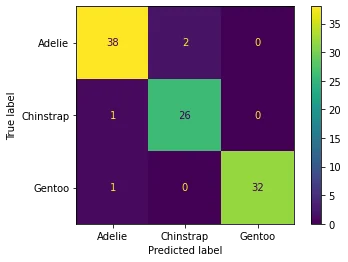
print(classification_report(y_test,base_pred)) precision recall f1-score support
Adelie 0.95 0.95 0.95 40
Chinstrap 0.93 0.96 0.95 27
Gentoo 1.00 0.97 0.98 334 more lines
    accuracy                           0.96       100
   macro avg       0.96      0.96      0.96       100
weighted avg 0.96 0.96 0.96 100model.feature_importances_array([0.33350103, 0.02010577, 0.57575804, 0. , 0.04491847,
0. , 0.02571668])pd.DataFrame(index=X.columns,data=model.feature_importances_,columns=['Feature Importance'])Feature Importance
culmen_length_mm
0.333501
culmen_depth_mm
0.02010610 more lines
flipper_length_mm
0.575758
body_mass_g
0.000000
island_Dream
0.044918
island_Torgersen
0.000000
sex_MALE
0.025717sns.boxplot(x='species',y='body_mass_g',data=df)<AxesSubplot:xlabel='species', ylabel='body_mass_g'>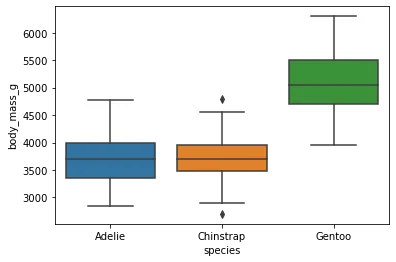
Visualize the Tree
This function is fairly new, you may want to review the online docs:
Online Documentation: https://scikit-learn.org/stable/modules/generated/sklearn.tree.plot_tree.html
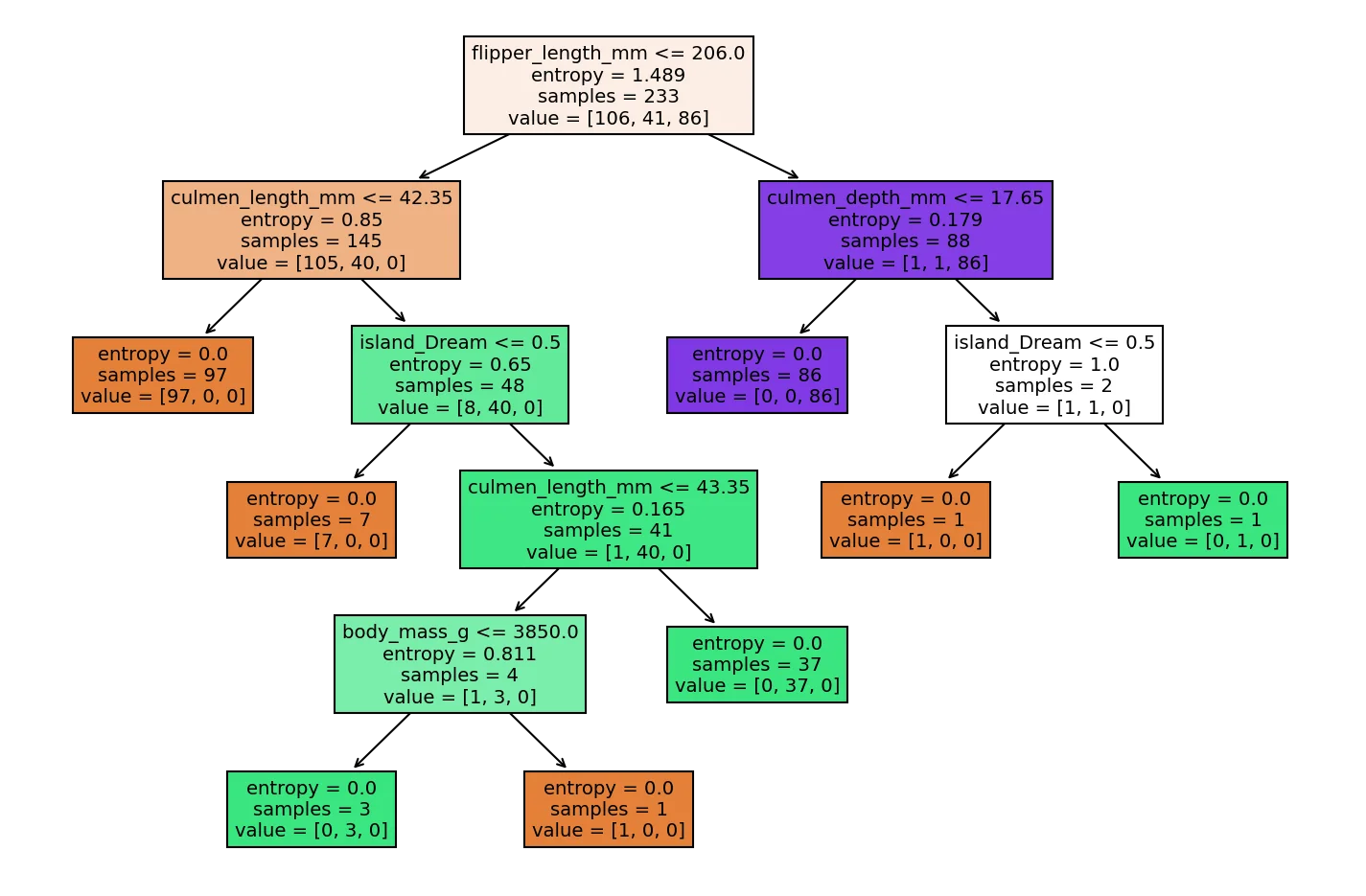
from sklearn.tree import plot_treeplt.figure(figsize=(12,8))
plot_tree(model);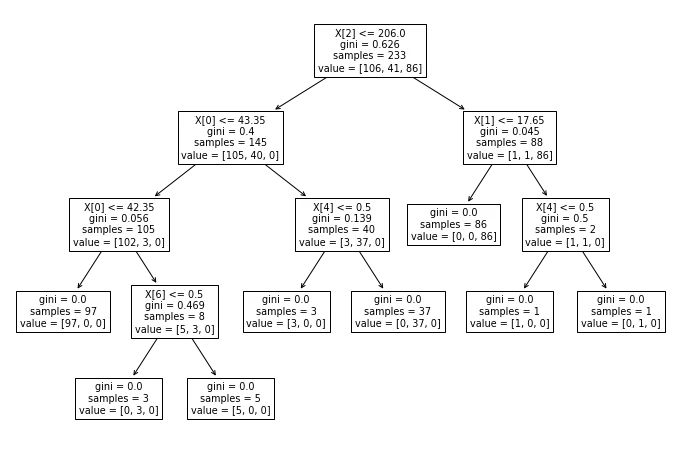
plt.figure(figsize=(12,8),dpi=150)
plot_tree(model,filled=True,feature_names=X.columns);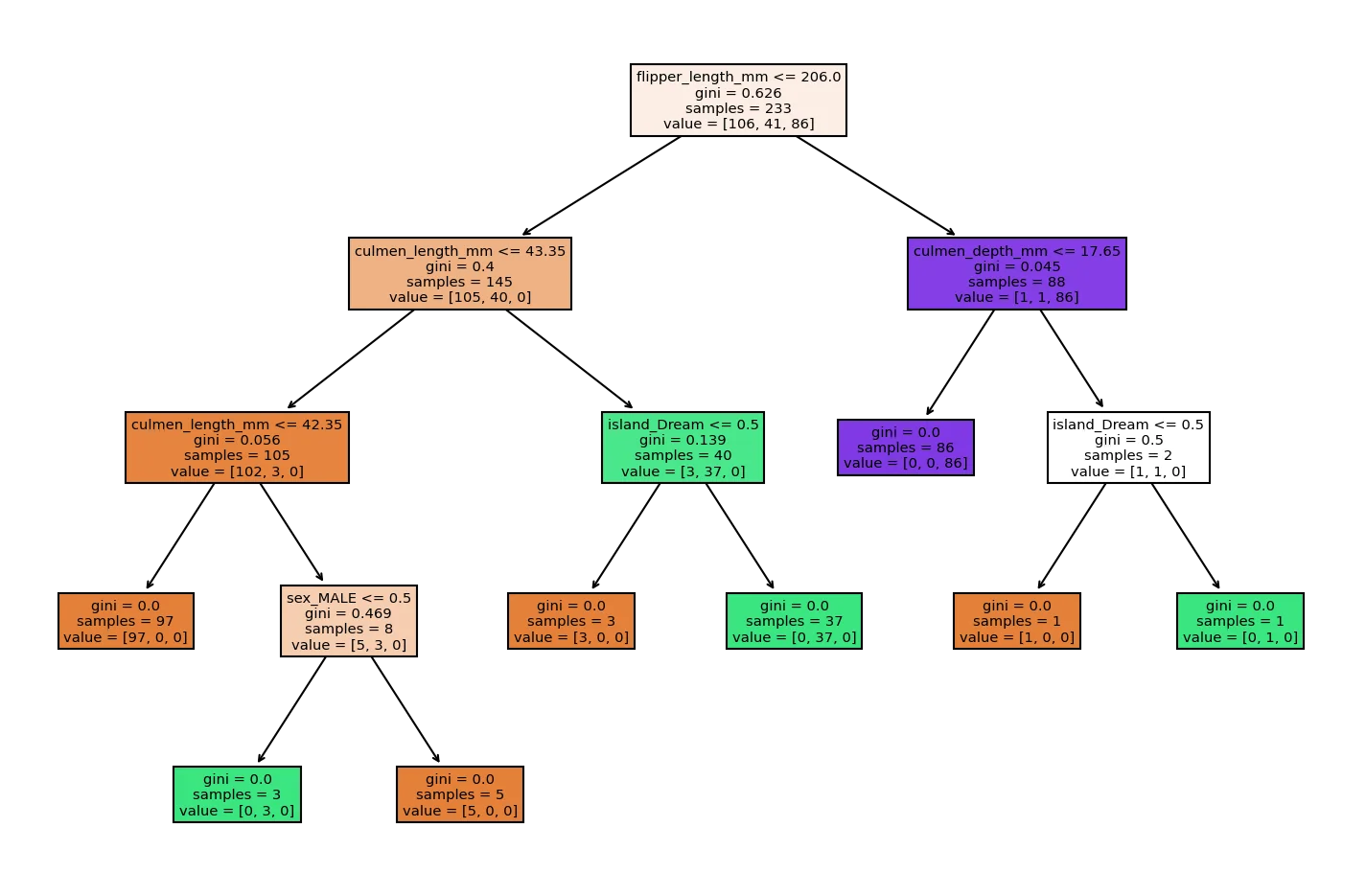
Reporting Model Results
To begin experimenting with hyperparameters, let's create a function that reports back classification results and plots out the tree.
def report_model(model):
    model_preds = model.predict(X_test)
    print(classification_report(y_test,model_preds))
    print('\n')
    plt.figure(figsize=(12,8),dpi=150)
    plot_tree(model,filled=True,feature_names=X.columns);
Understanding Hyperparameters
Max Depth
help(DecisionTreeClassifier)Help on class DecisionTreeClassifier in module sklearn.tree._classes:
class DecisionTreeClassifier(sklearn.base.ClassifierMixin, BaseDecisionTree)
| DecisionTreeClassifier(*, criterion='gini', splitter='best', max_depth=None, min_samples_split=2, min_samples_leaf=1, min_weight_fraction_leaf=0.0, max_features=None, random_state=None, max_leaf_nodes=None, min_impurity_decrease=0.0, min_impurity_split=None, class_weight=None, presort='deprecated', ccp_alpha=0.0)
| 536 more lines
 |  A decision tree classifier.
 |
 |  Read more in the :ref:`User Guide <tree>`.
 |
 |  Parameters
 |  ----------
 |  criterion : {"gini", "entropy"}, default="gini"
 |      The function to measure the quality of a split. Supported criteria are
 |      "gini" for the Gini impurity and "entropy" for the information gain.
 |
 |  splitter : {"best", "random"}, default="best"
 |      The strategy used to choose the split at each node. Supported
 |      strategies are "best" to choose the best split and "random" to choose
 |      the best random split.
 |
 |  max_depth : int, default=None
 |      The maximum depth of the tree. If None, then nodes are expanded until
 |      all leaves are pure or until all leaves contain less than
 |      min_samples_split samples.
 |
 |  min_samples_split : int or float, default=2
 |      The minimum number of samples required to split an internal node:
 |
 |      - If int, then consider `min_samples_split` as the minimum number.
 |      - If float, then `min_samples_split` is a fraction and
 |        `ceil(min_samples_split * n_samples)` are the minimum
 |        number of samples for each split.
 |
 |      .. versionchanged:: 0.18
 |         Added float values for fractions.
 |
 |  min_samples_leaf : int or float, default=1
 |      The minimum number of samples required to be at a leaf node.
 |      A split point at any depth will only be considered if it leaves at
 |      least ``min_samples_leaf`` training samples in each of the left and
 |      right branches.  This may have the effect of smoothing the model,
 |      especially in regression.
 |
 |      - If int, then consider `min_samples_leaf` as the minimum number.
 |      - If float, then `min_samples_leaf` is a fraction and
 |        `ceil(min_samples_leaf * n_samples)` are the minimum
 |        number of samples for each node.
 |
 |      .. versionchanged:: 0.18
 |         Added float values for fractions.
 |
 |  min_weight_fraction_leaf : float, default=0.0
 |      The minimum weighted fraction of the sum total of weights (of all
 |      the input samples) required to be at a leaf node. Samples have
 |      equal weight when sample_weight is not provided.
 |
 |  max_features : int, float or {"auto", "sqrt", "log2"}, default=None
 |      The number of features to consider when looking for the best split:
 |
 |          - If int, then consider `max_features` features at each split.
 |          - If float, then `max_features` is a fraction and
 |            `int(max_features * n_features)` features are considered at each
 |            split.
 |          - If "auto", then `max_features=sqrt(n_features)`.
 |          - If "sqrt", then `max_features=sqrt(n_features)`.
 |          - If "log2", then `max_features=log2(n_features)`.
 |          - If None, then `max_features=n_features`.
 |
 |      Note: the search for a split does not stop until at least one
 |      valid partition of the node samples is found, even if it requires to
 |      effectively inspect more than ``max_features`` features.
 |
 |  random_state : int, RandomState instance, default=None
 |      Controls the randomness of the estimator. The features are always
 |      randomly permuted at each split, even if ``splitter`` is set to
 |      ``"best"``. When ``max_features < n_features``, the algorithm will
 |      select ``max_features`` at random at each split before finding the best
 |      split among them. But the best found split may vary across different
 |      runs, even if ``max_features=n_features``. That is the case, if the
 |      improvement of the criterion is identical for several splits and one
 |      split has to be selected at random. To obtain a deterministic behaviour
 |      during fitting, ``random_state`` has to be fixed to an integer.
 |      See :term:`Glossary <random_state>` for details.
 |
 |  max_leaf_nodes : int, default=None
 |      Grow a tree with ``max_leaf_nodes`` in best-first fashion.
 |      Best nodes are defined as relative reduction in impurity.
 |      If None then unlimited number of leaf nodes.
 |
 |  min_impurity_decrease : float, default=0.0
 |      A node will be split if this split induces a decrease of the impurity
 |      greater than or equal to this value.
 |
 |      The weighted impurity decrease equation is the following::
 |
 |          N_t / N * (impurity - N_t_R / N_t * right_impurity
 |                              - N_t_L / N_t * left_impurity)
 |
 |      where ``N`` is the total number of samples, ``N_t`` is the number of
 |      samples at the current node, ``N_t_L`` is the number of samples in the
 |      left child, and ``N_t_R`` is the number of samples in the right child.
 |
 |      ``N``, ``N_t``, ``N_t_R`` and ``N_t_L`` all refer to the weighted sum,
 |      if ``sample_weight`` is passed.
 |
 |      .. versionadded:: 0.19
 |
 |  min_impurity_split : float, default=0
 |      Threshold for early stopping in tree growth. A node will split
 |      if its impurity is above the threshold, otherwise it is a leaf.
 |
 |      .. deprecated:: 0.19
 |         ``min_impurity_split`` has been deprecated in favor of
 |         ``min_impurity_decrease`` in 0.19. The default value of
 |         ``min_impurity_split`` has changed from 1e-7 to 0 in 0.23 and it
 |         will be removed in 0.25. Use ``min_impurity_decrease`` instead.
 |
 |  class_weight : dict, list of dict or "balanced", default=None
 |      Weights associated with classes in the form ``{class_label: weight}``.
 |      If None, all classes are supposed to have weight one. For
 |      multi-output problems, a list of dicts can be provided in the same
 |      order as the columns of y.
 |
 |      Note that for multioutput (including multilabel) weights should be
 |      defined for each class of every column in its own dict. For example,
 |      for four-class multilabel classification weights should be
 |      [{0: 1, 1: 1}, {0: 1, 1: 5}, {0: 1, 1: 1}, {0: 1, 1: 1}] instead of
 |      [{1:1}, {2:5}, {3:1}, {4:1}].
 |
 |      The "balanced" mode uses the values of y to automatically adjust
 |      weights inversely proportional to class frequencies in the input data
 |      as ``n_samples / (n_classes * np.bincount(y))``
 |
 |      For multi-output, the weights of each column of y will be multiplied.
 |
 |      Note that these weights will be multiplied with sample_weight (passed
 |      through the fit method) if sample_weight is specified.
 |
 |  presort : deprecated, default='deprecated'
 |      This parameter is deprecated and will be removed in v0.24.
 |
 |      .. deprecated:: 0.22
 |
 |  ccp_alpha : non-negative float, default=0.0
 |      Complexity parameter used for Minimal Cost-Complexity Pruning. The
 |      subtree with the largest cost complexity that is smaller than
 |      ``ccp_alpha`` will be chosen. By default, no pruning is performed. See
 |      :ref:`minimal_cost_complexity_pruning` for details.
 |
 |      .. versionadded:: 0.22
 |
 |  Attributes
 |  ----------
 |  classes_ : ndarray of shape (n_classes,) or list of ndarray
 |      The classes labels (single output problem),
 |      or a list of arrays of class labels (multi-output problem).
 |
 |  feature_importances_ : ndarray of shape (n_features,)
 |      The impurity-based feature importances.
 |      The higher, the more important the feature.
 |      The importance of a feature is computed as the (normalized)
 |      total reduction of the criterion brought by that feature.  It is also
 |      known as the Gini importance [4]_.
 |
 |      Warning: impurity-based feature importances can be misleading for
 |      high cardinality features (many unique values). See
 |      :func:`sklearn.inspection.permutation_importance` as an alternative.
 |
 |  max_features_ : int
 |      The inferred value of max_features.
 |
 |  n_classes_ : int or list of int
 |      The number of classes (for single output problems),
 |      or a list containing the number of classes for each
 |      output (for multi-output problems).
 |
 |  n_features_ : int
 |      The number of features when ``fit`` is performed.
 |
 |  n_outputs_ : int
 |      The number of outputs when ``fit`` is performed.
 |
 |  tree_ : Tree
 |      The underlying Tree object. Please refer to
 |      ``help(sklearn.tree._tree.Tree)`` for attributes of Tree object and
 |      :ref:`sphx_glr_auto_examples_tree_plot_unveil_tree_structure.py`
 |      for basic usage of these attributes.
 |
 |  See Also
 |  --------
 |  DecisionTreeRegressor : A decision tree regressor.
 |
 |  Notes
 |  -----
 |  The default values for the parameters controlling the size of the trees
 |  (e.g. ``max_depth``, ``min_samples_leaf``, etc.) lead to fully grown and
 |  unpruned trees which can potentially be very large on some data sets. To
 |  reduce memory consumption, the complexity and size of the trees should be
 |  controlled by setting those parameter values.
 |
 |  References
 |  ----------
 |
 |  .. [1] https://en.wikipedia.org/wiki/Decision_tree_learning
 |
 |  .. [2] L. Breiman, J. Friedman, R. Olshen, and C. Stone, "Classification
 |         and Regression Trees", Wadsworth, Belmont, CA, 1984.
 |
 |  .. [3] T. Hastie, R. Tibshirani and J. Friedman. "Elements of Statistical
 |         Learning", Springer, 2009.
 |
 |  .. [4] L. Breiman, and A. Cutler, "Random Forests",
 |         https://www.stat.berkeley.edu/~breiman/RandomForests/cc_home.htm
 |
 |  Examples
 |  --------
 |  >>> from sklearn.datasets import load_iris
 |  >>> from sklearn.model_selection import cross_val_score
 |  >>> from sklearn.tree import DecisionTreeClassifier
 |  >>> clf = DecisionTreeClassifier(random_state=0)
 |  >>> iris = load_iris()
 |  >>> cross_val_score(clf, iris.data, iris.target, cv=10)
 |  ...                             # doctest: +SKIP
 |  ...
 |  array([ 1.     ,  0.93...,  0.86...,  0.93...,  0.93...,
 |          0.93...,  0.93...,  1.     ,  0.93...,  1.      ])
 |
 |  Method resolution order:
 |      DecisionTreeClassifier
 |      sklearn.base.ClassifierMixin
 |      BaseDecisionTree
 |      sklearn.base.MultiOutputMixin
 |      sklearn.base.BaseEstimator
 |      builtins.object
 |
 |  Methods defined here:
 |
 |  __init__(self, *, criterion='gini', splitter='best', max_depth=None, min_samples_split=2, min_samples_leaf=1, min_weight_fraction_leaf=0.0, max_features=None, random_state=None, max_leaf_nodes=None, min_impurity_decrease=0.0, min_impurity_split=None, class_weight=None, presort='deprecated', ccp_alpha=0.0)
 |      Initialize self.  See help(type(self)) for accurate signature.
 |
 |  fit(self, X, y, sample_weight=None, check_input=True, X_idx_sorted=None)
 |      Build a decision tree classifier from the training set (X, y).
 |
 |      Parameters
 |      ----------
 |      X : {array-like, sparse matrix} of shape (n_samples, n_features)
 |          The training input samples. Internally, it will be converted to
 |          ``dtype=np.float32`` and if a sparse matrix is provided
 |          to a sparse ``csc_matrix``.
 |
 |      y : array-like of shape (n_samples,) or (n_samples, n_outputs)
 |          The target values (class labels) as integers or strings.
 |
 |      sample_weight : array-like of shape (n_samples,), default=None
 |          Sample weights. If None, then samples are equally weighted. Splits
 |          that would create child nodes with net zero or negative weight are
 |          ignored while searching for a split in each node. Splits are also
 |          ignored if they would result in any single class carrying a
 |          negative weight in either child node.
 |
 |      check_input : bool, default=True
 |          Allow to bypass several input checking.
 |          Don't use this parameter unless you know what you do.
 |
 |      X_idx_sorted : array-like of shape (n_samples, n_features),                 default=None
 |          The indexes of the sorted training input samples. If many tree
 |          are grown on the same dataset, this allows the ordering to be
 |          cached between trees. If None, the data will be sorted here.
 |          Don't use this parameter unless you know what to do.
 |
 |      Returns
 |      -------
 |      self : DecisionTreeClassifier
 |          Fitted estimator.
 |
 |  predict_log_proba(self, X)
 |      Predict class log-probabilities of the input samples X.
 |
 |      Parameters
 |      ----------
 |      X : {array-like, sparse matrix} of shape (n_samples, n_features)
 |          The input samples. Internally, it will be converted to
 |          ``dtype=np.float32`` and if a sparse matrix is provided
 |          to a sparse ``csr_matrix``.
 |
 |      Returns
 |      -------
 |      proba : ndarray of shape (n_samples, n_classes) or list of n_outputs             such arrays if n_outputs > 1
 |          The class log-probabilities of the input samples. The order of the
 |          classes corresponds to that in the attribute :term:`classes_`.
 |
 |  predict_proba(self, X, check_input=True)
 |      Predict class probabilities of the input samples X.
 |
 |      The predicted class probability is the fraction of samples of the same
 |      class in a leaf.
 |
 |      Parameters
 |      ----------
 |      X : {array-like, sparse matrix} of shape (n_samples, n_features)
 |          The input samples. Internally, it will be converted to
 |          ``dtype=np.float32`` and if a sparse matrix is provided
 |          to a sparse ``csr_matrix``.
 |
 |      check_input : bool, default=True
 |          Allow to bypass several input checking.
 |          Don't use this parameter unless you know what you do.
 |
 |      Returns
 |      -------
 |      proba : ndarray of shape (n_samples, n_classes) or list of n_outputs             such arrays if n_outputs > 1
 |          The class probabilities of the input samples. The order of the
 |          classes corresponds to that in the attribute :term:`classes_`.
 |
 |  ----------------------------------------------------------------------
 |  Data and other attributes defined here:
 |
 |  __abstractmethods__ = frozenset()
 |
 |  ----------------------------------------------------------------------
 |  Methods inherited from sklearn.base.ClassifierMixin:
 |
 |  score(self, X, y, sample_weight=None)
 |      Return the mean accuracy on the given test data and labels.
 |
 |      In multi-label classification, this is the subset accuracy
 |      which is a harsh metric since you require for each sample that
 |      each label set be correctly predicted.
 |
 |      Parameters
 |      ----------
 |      X : array-like of shape (n_samples, n_features)
 |          Test samples.
 |
 |      y : array-like of shape (n_samples,) or (n_samples, n_outputs)
 |          True labels for X.
 |
 |      sample_weight : array-like of shape (n_samples,), default=None
 |          Sample weights.
 |
 |      Returns
 |      -------
 |      score : float
 |          Mean accuracy of self.predict(X) wrt. y.
 |
 |  ----------------------------------------------------------------------
 |  Data descriptors inherited from sklearn.base.ClassifierMixin:
 |
 |  __dict__
 |      dictionary for instance variables (if defined)
 |
 |  __weakref__
 |      list of weak references to the object (if defined)
 |
 |  ----------------------------------------------------------------------
 |  Methods inherited from BaseDecisionTree:
 |
 |  apply(self, X, check_input=True)
 |      Return the index of the leaf that each sample is predicted as.
 |
 |      .. versionadded:: 0.17
 |
 |      Parameters
 |      ----------
 |      X : {array-like, sparse matrix} of shape (n_samples, n_features)
 |          The input samples. Internally, it will be converted to
 |          ``dtype=np.float32`` and if a sparse matrix is provided
 |          to a sparse ``csr_matrix``.
 |
 |      check_input : bool, default=True
 |          Allow to bypass several input checking.
 |          Don't use this parameter unless you know what you do.
 |
 |      Returns
 |      -------
 |      X_leaves : array-like of shape (n_samples,)
 |          For each datapoint x in X, return the index of the leaf x
 |          ends up in. Leaves are numbered within
 |          ``[0; self.tree_.node_count)``, possibly with gaps in the
 |          numbering.
 |
 |  cost_complexity_pruning_path(self, X, y, sample_weight=None)
 |      Compute the pruning path during Minimal Cost-Complexity Pruning.
 |
 |      See :ref:`minimal_cost_complexity_pruning` for details on the pruning
 |      process.
 |
 |      Parameters
 |      ----------
 |      X : {array-like, sparse matrix} of shape (n_samples, n_features)
 |          The training input samples. Internally, it will be converted to
 |          ``dtype=np.float32`` and if a sparse matrix is provided
 |          to a sparse ``csc_matrix``.
 |
 |      y : array-like of shape (n_samples,) or (n_samples, n_outputs)
 |          The target values (class labels) as integers or strings.
 |
 |      sample_weight : array-like of shape (n_samples,), default=None
 |          Sample weights. If None, then samples are equally weighted. Splits
 |          that would create child nodes with net zero or negative weight are
 |          ignored while searching for a split in each node. Splits are also
 |          ignored if they would result in any single class carrying a
 |          negative weight in either child node.
 |
 |      Returns
 |      -------
 |      ccp_path : :class:`~sklearn.utils.Bunch`
 |          Dictionary-like object, with the following attributes.
 |
 |          ccp_alphas : ndarray
 |              Effective alphas of subtree during pruning.
 |
 |          impurities : ndarray
 |              Sum of the impurities of the subtree leaves for the
 |              corresponding alpha value in ``ccp_alphas``.
 |
 |  decision_path(self, X, check_input=True)
 |      Return the decision path in the tree.
 |
 |      .. versionadded:: 0.18
 |
 |      Parameters
 |      ----------
 |      X : {array-like, sparse matrix} of shape (n_samples, n_features)
 |          The input samples. Internally, it will be converted to
 |          ``dtype=np.float32`` and if a sparse matrix is provided
 |          to a sparse ``csr_matrix``.
 |
 |      check_input : bool, default=True
 |          Allow to bypass several input checking.
 |          Don't use this parameter unless you know what you do.
 |
 |      Returns
 |      -------
 |      indicator : sparse matrix of shape (n_samples, n_nodes)
 |          Return a node indicator CSR matrix where non zero elements
 |          indicates that the samples goes through the nodes.
 |
 |  get_depth(self)
 |      Return the depth of the decision tree.
 |
 |      The depth of a tree is the maximum distance between the root
 |      and any leaf.
 |
 |      Returns
 |      -------
 |      self.tree_.max_depth : int
 |          The maximum depth of the tree.
 |
 |  get_n_leaves(self)
 |      Return the number of leaves of the decision tree.
 |
 |      Returns
 |      -------
 |      self.tree_.n_leaves : int
 |          Number of leaves.
 |
 |  predict(self, X, check_input=True)
 |      Predict class or regression value for X.
 |
 |      For a classification model, the predicted class for each sample in X is
 |      returned. For a regression model, the predicted value based on X is
 |      returned.
 |
 |      Parameters
 |      ----------
 |      X : {array-like, sparse matrix} of shape (n_samples, n_features)
 |          The input samples. Internally, it will be converted to
 |          ``dtype=np.float32`` and if a sparse matrix is provided
 |          to a sparse ``csr_matrix``.
 |
 |      check_input : bool, default=True
 |          Allow to bypass several input checking.
 |          Don't use this parameter unless you know what you do.
 |
 |      Returns
 |      -------
 |      y : array-like of shape (n_samples,) or (n_samples, n_outputs)
 |          The predicted classes, or the predict values.
 |
 |  ----------------------------------------------------------------------
 |  Data descriptors inherited from BaseDecisionTree:
 |
 |  feature_importances_
 |      Return the feature importances.
 |
 |      The importance of a feature is computed as the (normalized) total
 |      reduction of the criterion brought by that feature.
 |      It is also known as the Gini importance.
 |
 |      Warning: impurity-based feature importances can be misleading for
 |      high cardinality features (many unique values). See
 |      :func:`sklearn.inspection.permutation_importance` as an alternative.
 |
 |      Returns
 |      -------
 |      feature_importances_ : ndarray of shape (n_features,)
 |          Normalized total reduction of criteria by feature
 |          (Gini importance).
 |
 |  ----------------------------------------------------------------------
 |  Methods inherited from sklearn.base.BaseEstimator:
 |
 |  __getstate__(self)
 |
 |  __repr__(self, N_CHAR_MAX=700)
 |      Return repr(self).
 |
 |  __setstate__(self, state)
 |
 |  get_params(self, deep=True)
 |      Get parameters for this estimator.
 |
 |      Parameters
 |      ----------
 |      deep : bool, default=True
 |          If True, will return the parameters for this estimator and
 |          contained subobjects that are estimators.
 |
 |      Returns
 |      -------
 |      params : mapping of string to any
 |          Parameter names mapped to their values.
 |
 |  set_params(self, **params)
 |      Set the parameters of this estimator.
 |
 |      The method works on simple estimators as well as on nested objects
 |      (such as pipelines). The latter have parameters of the form
 |      ``<component>__<parameter>`` so that it's possible to update each
 |      component of a nested object.
 |
 |      Parameters
 |      ----------
 |      **params : dict
 |          Estimator parameters.
 |
 |      Returns
 |      -------
 |      self : object
| Estimator instance.pruned_tree = DecisionTreeClassifier(max_depth=2)
pruned_tree.fit(X_train,y_train)DecisionTreeClassifier(max_depth=2)report_model(pruned_tree) precision recall f1-score support
Adelie 0.87 0.97 0.92 40
Chinstrap 0.91 0.78 0.84 27
Gentoo 1.00 0.97 0.98 334 more lines
    accuracy                           0.92       100
   macro avg       0.93      0.91      0.91       100
weighted avg       0.92      0.92      0.92       100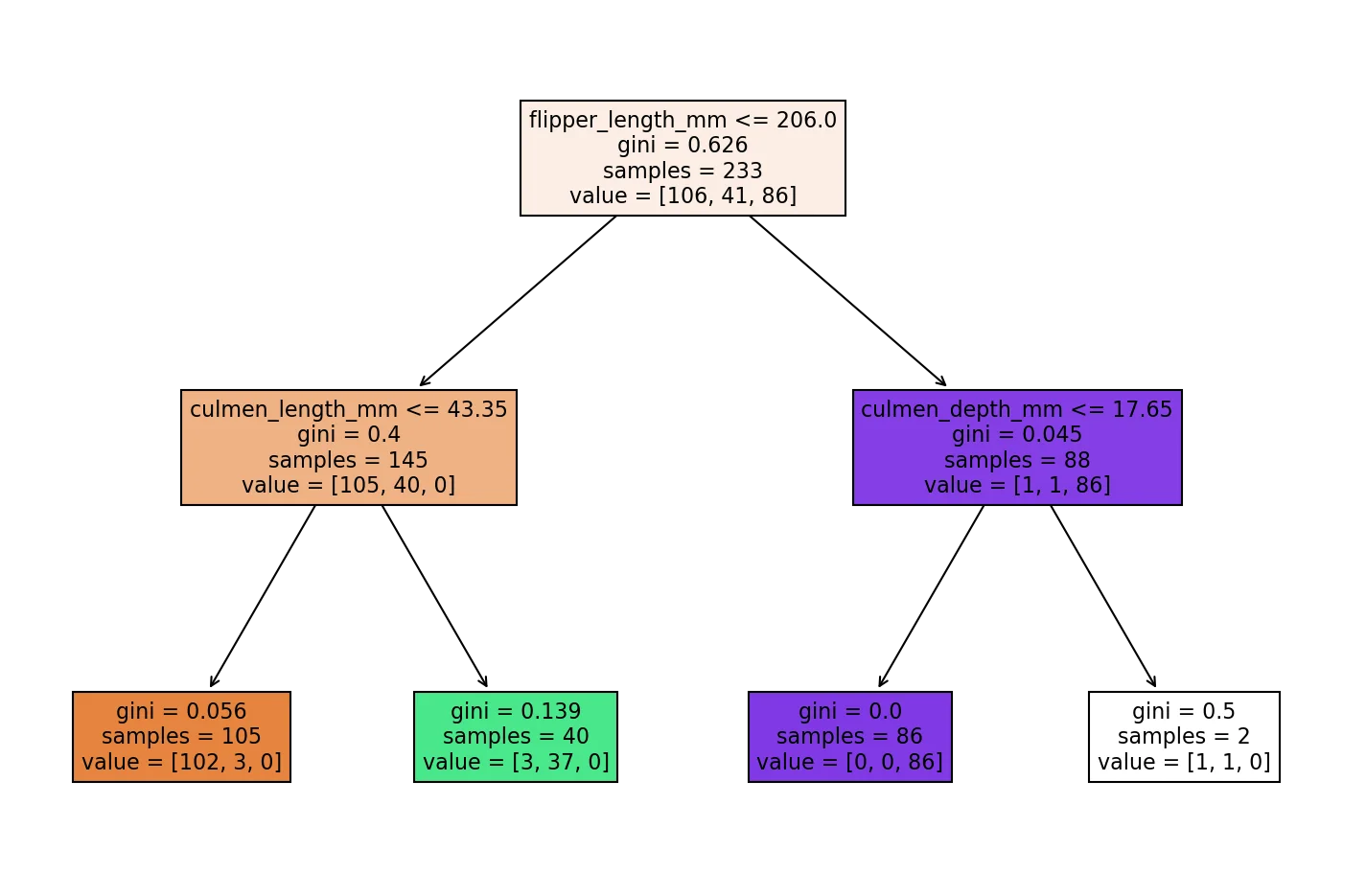
Max Leaf Nodes
pruned_tree = DecisionTreeClassifier(max_leaf_nodes=3)
pruned_tree.fit(X_train,y_train)DecisionTreeClassifier(max_leaf_nodes=3)report_model(pruned_tree) precision recall f1-score support
Adelie 0.95 0.95 0.95 40
Chinstrap 0.91 0.78 0.84 27
Gentoo 0.86 0.97 0.91 334 more lines
    accuracy                           0.91       100
   macro avg       0.91      0.90      0.90       100
weighted avg       0.91      0.91      0.91       100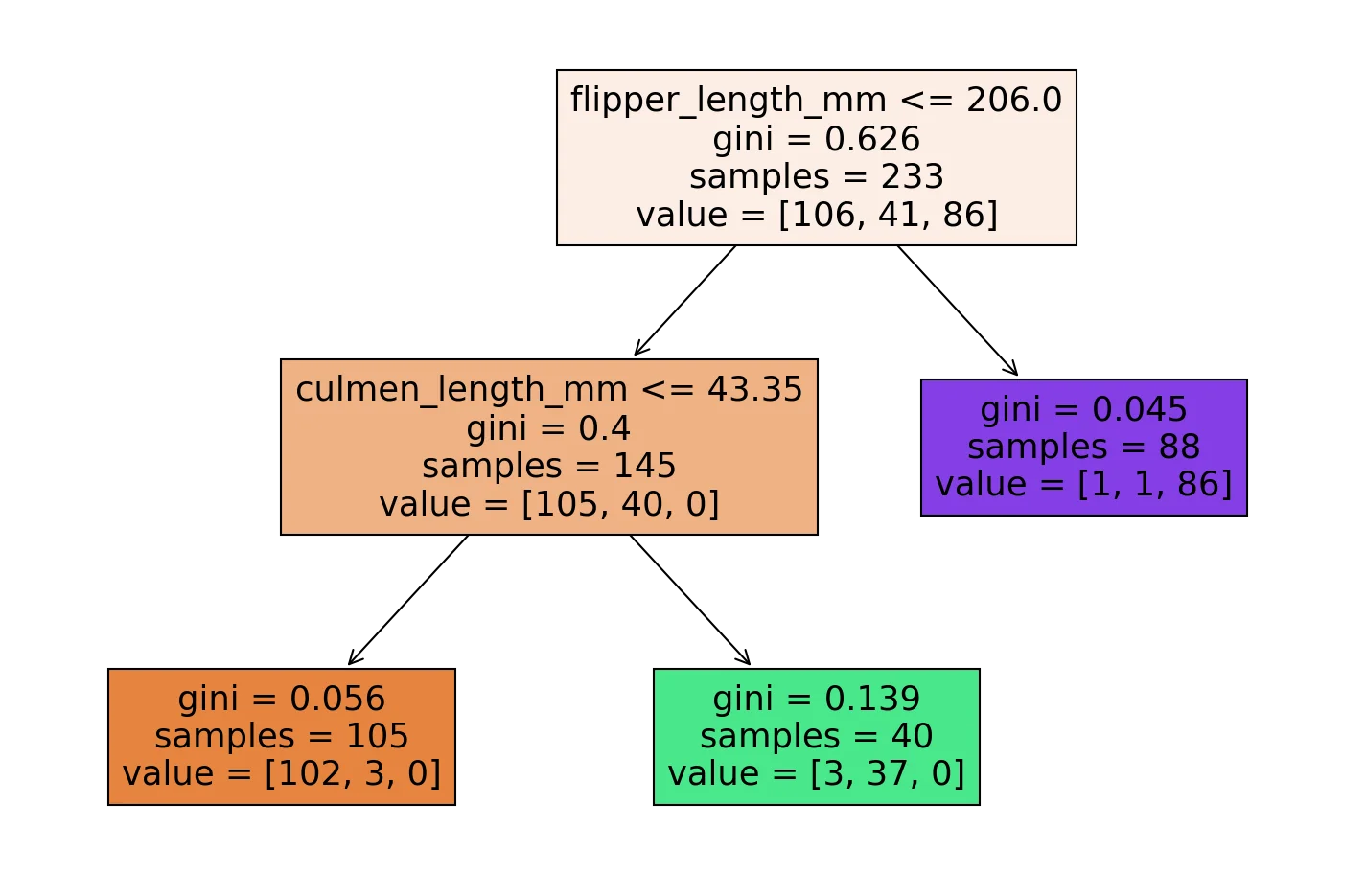
Criterion
entropy_tree = DecisionTreeClassifier(criterion='entropy')
entropy_tree.fit(X_train,y_train)DecisionTreeClassifier(criterion='entropy')report_model(entropy_tree) precision recall f1-score support
Adelie 0.95 0.95 0.95 40
Chinstrap 0.93 0.96 0.95 27
Gentoo 1.00 0.97 0.98 334 more lines
    accuracy                           0.96       100
   macro avg       0.96      0.96      0.96       100
weighted avg       0.96      0.96      0.96       100